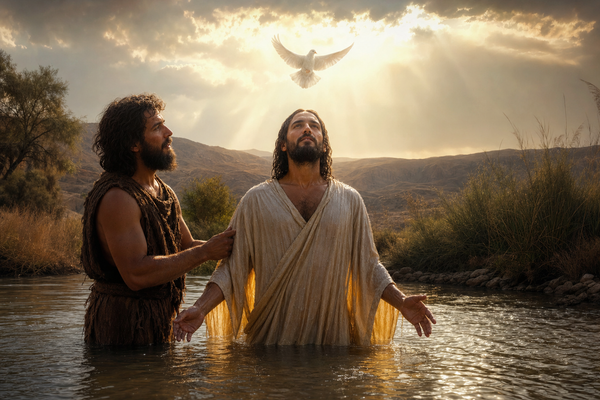
When Was Jesus Baptized, and How Old Was He? A Biblical Timeline
Jesus was baptized at about thirty years old, likely between AD 26 and AD 29, just before His public ministry began. His baptism revealed His identity and His willing identification with the sinners He came to save.
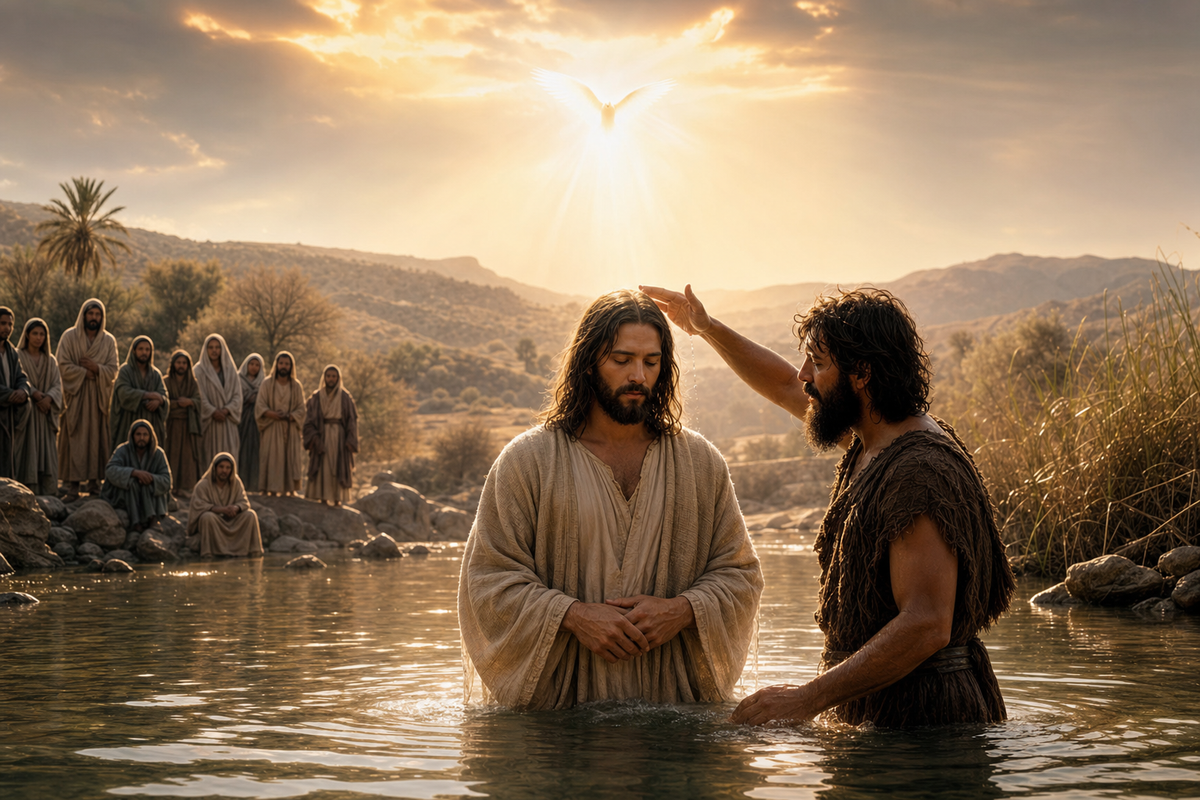
The Bible does not give an exact calendar date for Jesus’ baptism, but it does tell us His approximate age and where the event fits in His life. According to Luke, Jesus was about thirty years old when He began His public ministry. His baptism by John took place immediately before that ministry began, followed by His temptation in the wilderness.
That means the clearest biblical answer is that Jesus was baptized at approximately age thirty, likely sometime between AD 26 and AD 29. The precise year remains uncertain because ancient dating systems and the chronology of Jesus’ birth are not as exact as modern calendars.
Yet the Gospels are far more interested in the meaning of the moment than in its date. Jesus’ baptism revealed His identity, marked the beginning of His public work, and showed how fully He had come to stand in the place of sinners—even though He Himself was without sin.
The Short Biblical Answer
Luke provides the most direct statement about Jesus’ age:
“Jesus, when he began his ministry, was about thirty years of age” (Luke 3:23).
This verse appears immediately after Luke’s account of Jesus’ baptism. John the Baptist had been calling Israel to repentance and baptizing people in the Jordan River. Jesus came to John, was baptized, prayed, and received the visible descent of the Holy Spirit. The Father then spoke from heaven.
Because Luke connects these events so closely, Christians have long understood that Jesus was about thirty when John baptized Him. The word about matters. Luke gives an approximation rather than an exact birthday-based calculation. Jesus may have been thirty, or He may have been a little older.
Scripture also does not identify the day or month of the baptism. Christian traditions commemorate the baptism of Jesus on particular feast days, but those observances should not be mistaken for a historically certain date. The Bible simply does not tell us the exact day.
All three Synoptic Gospels record the baptism near the opening of Jesus’ public ministry. Matthew 3:13 says, “Then Jesus came from Galilee to the Jordan to John, to be baptized by him.” Mark introduces it similarly: “In those days Jesus came from Nazareth of Galilee and was baptized by John in the Jordan” (Mark 1:9). Luke places it after John’s preaching and before Jesus’ genealogy and temptation.
The accounts agree on the essential sequence: Jesus lived in relative obscurity in Nazareth, John began preaching, Jesus came to the Jordan, and His baptism marked the transition into His public ministry.
Where the Baptism Fits in the Timeline
Luke gives the strongest historical marker for estimating when the baptism occurred. He says John the Baptist’s ministry began in “the fifteenth year of the reign of Tiberius Caesar” (Luke 3:1). Tiberius became the Roman emperor after Augustus died in AD 14. If Luke counted from the beginning of Tiberius’s sole reign, the fifteenth year would fall around AD 28 or 29. Some chronologies count from an earlier period when Tiberius shared imperial authority, producing a date around AD 26 or 27.
For this reason, many biblical timelines place Jesus’ baptism somewhere between AD 26 and AD 29. The range reflects genuine historical uncertainty rather than a contradiction in Scripture.
The date of Jesus’ birth also affects attempts to calculate His exact age. Matthew indicates that Jesus was born before the death of Herod the Great. Herod’s death is commonly dated to 4 BC, leading many scholars to place Jesus’ birth around 6 to 4 BC. Our BC and AD calendar was developed centuries later and appears to have placed Jesus’ birth a few years too late. There is also no year zero between 1 BC and AD 1.
If Jesus was born several years before 1 BC and baptized in the late AD 20s, He may have been in His early thirties by modern calculations. That fits Luke’s intentionally flexible wording: He was “about thirty years of age.” The responsible conclusion is not to force an exact age that Scripture does not provide, but to accept the approximation Luke gives.
Before this event, very little is recorded about Jesus’ adult life. Luke tells us about Jesus at twelve years old in the temple and then summarizes the years that followed: “Jesus increased in wisdom and in stature and in favor with God and man” (Luke 2:52). He lived in submission to Mary and Joseph, grew up in Nazareth, and was known as a carpenter or craftsman. Nearly two decades pass without detailed narration.
Then John appeared in the wilderness, preaching, “Repent, for the kingdom of heaven is at hand” (Matthew 3:2). Crowds came to confess their sins and be baptized. Jesus traveled from Galilee to the Jordan to meet him. After His baptism, the Spirit led Him into the wilderness, where He was tempted for forty days. He then began proclaiming the kingdom, calling disciples, teaching, healing, and moving steadily toward the cross.
Some readers wonder whether age thirty carried a special requirement. Numbers 4 describes certain Levites beginning tabernacle service at thirty, and David was thirty when he became king (2 Samuel 5:4). These passages may create meaningful biblical resonances, but Scripture never says Jesus had to wait until thirty because every Jewish teacher or priest was subject to such a rule. Jesus belonged to the tribe of Judah, not Levi, and His priesthood was of a different order. Luke’s statement is primarily a chronological marker, not a command establishing thirty as the required age for ministry or baptism.
Why the Sinless Jesus Was Baptized
John’s baptism was associated with repentance. Mark says John was “proclaiming a baptism of repentance for the forgiveness of sins” (Mark 1:4). This creates an important question: if Jesus never sinned, why did He receive a baptism meant for repentant people?
John himself recognized the difficulty. When Jesus approached him, John objected: “I need to be baptized by you, and do you come to me?” (Matthew 3:14). John knew that Jesus did not come as one more guilty person needing cleansing.
Jesus answered, “Let it be so now, for thus it is fitting for us to fulfill all righteousness” (Matthew 3:15). His baptism was an act of righteous obedience to the Father’s saving purpose. It did not mean Jesus was confessing personal sin. Scripture consistently teaches that He was sinless. He “knew no sin” (2 Corinthians 5:21), was “without sin” (Hebrews 4:15), and “committed no sin” (1 Peter 2:22).
By entering the waters, Jesus identified Himself with the people He had come to save. He stood among sinners without becoming sinful. This pattern would reach its fullest expression at the cross, where the innocent Son of God bore the judgment His people deserved. His baptism anticipated His willingness to take the sinner’s place.
Jesus later used the language of baptism when speaking about His approaching suffering. He asked His disciples, “Are you able to drink the cup that I drink, or to be baptized with the baptism with which I am baptized?” (Mark 10:38). His immersion in the Jordan did not accomplish atonement, but it pointed forward to the deeper baptism of suffering and death He would endure.
The baptism also publicly inaugurated His messianic mission. Jesus had always been the eternal Son of God; He did not become God’s Son at the Jordan. Nor was this the moment when He first became morally righteous. Rather, the Father publicly declared who He was, and the Spirit visibly rested upon Him as He began His appointed work.
Isaiah had prophesied about the Lord’s Servant: “Behold my servant, whom I uphold, my chosen, in whom my soul delights; I have put my Spirit upon him” (Isaiah 42:1). The baptism of Jesus echoes this promise. He is the beloved Servant and anointed King who will bring justice, bear sin, and faithfully accomplish the Father’s will.
What Happened at the Jordan
Each Gospel account emphasizes particular details, but together they give a rich picture of the event. Jesus came from Nazareth in Galilee to the Jordan River, where John was baptizing. John initially resisted, but he obeyed Jesus and baptized Him.
Luke adds that Jesus was praying as heaven opened. Then “the Holy Spirit descended on him in bodily form, like a dove” (Luke 3:22). The comparison does not necessarily mean the Spirit was an ordinary dove. Luke describes a visible, dove-like manifestation through which the Spirit’s descent could be witnessed.
A voice then came from heaven: “You are my beloved Son; with you I am well pleased” (Luke 3:22). Matthew records the declaration in a form addressed to those present: “This is my beloved Son, with whom I am well pleased” (Matthew 3:17).
This scene offers one of Scripture’s clearest revelations of the Father, Son, and Holy Spirit acting distinctly and in perfect unity. The Son stands in the water, the Spirit descends upon Him, and the Father speaks from heaven. The passage does not give a complete explanation of the Trinity, but it does not allow us to collapse the Father, Son, and Spirit into one person merely appearing in different forms.
The Father’s words also draw together major Old Testament themes. “My Son” recalls the royal language of Psalm 2:7, where God speaks of His anointed King. “With whom I am well pleased” recalls the chosen Servant of Isaiah 42:1. Jesus is both the promised King and the obedient Servant. He will rule, but He will do so by serving, suffering, and giving His life.
Immediately afterward, the Spirit led Jesus into the wilderness. There He faced Satan’s temptations and remained obedient where Adam and Israel had failed. The baptism was therefore not an isolated spiritual experience. It was the beginning of a mission characterized by obedience, testing, proclamation, compassion, sacrifice, and final victory.
The Gospels do not let us separate the Father’s delight in the Son from the path the Son was about to walk. Jesus’ identity was affirmed before His public miracles and before the crowds gathered around Him. Yet the Father’s pleasure did not mean Jesus would avoid suffering. His beloved Son would travel toward rejection and crucifixion, accomplishing salvation through perfect obedience.
Why Jesus’ Baptism Still Matters
Jesus’ age at baptism helps us place the event historically, but the deeper value of the passage lies in what it reveals about Him. The Jordan points us toward the identity and mission of Christ.
First, His baptism shows His humility. The One who had no sin willingly stood in a line of people confessing theirs. He did not remain distant from the brokenness He came to redeem. He entered our world fully, submitted to the Father, and identified with those who needed mercy.
Second, the event reveals that salvation is the work of the triune God. The Father sends and delights in the Son. The Son obeys and gives Himself. The Holy Spirit rests upon and empowers the Son’s messianic ministry. The one God acts in perfect unity to accomplish redemption.
Third, Jesus’ baptism directs attention toward His death and resurrection. Christian baptism later becomes a sign of union with Christ in those saving events. Paul writes, “We were buried therefore with him by baptism into death, in order that, just as Christ was raised from the dead by the glory of the Father, we too might walk in newness of life” (Romans 6:4). The water itself does not replace faith in Christ; it visibly declares the believer’s identification with the crucified and risen Lord.
Jesus being about thirty does not mean Christians must wait until that age to be baptized, begin serving God, or pursue their calling. The New Testament never establishes thirty as a universal spiritual threshold. The significance of Jesus’ age is chronological: His baptism marked the end of His largely hidden years in Nazareth and the beginning of His public ministry.
It is also worth noticing the patience within that timeline. Jesus did not act independently of the Father’s appointed time. For many years, He lived faithfully in ordinary circumstances before His public work began. Those years were not wasted, even though Scripture tells us little about them. Faithfulness is not measured only by public visibility. Jesus’ hidden life reminds us that obedience before God matters even when it is unnoticed by others.
At the same time, this passage calls us beyond mere curiosity about dates. It is possible to know that Jesus was around thirty and still miss what the Father announced about Him. He is the beloved Son, the promised King, and the faithful Servant. The central question is not simply whether we can reconstruct the year of His baptism, but whether we recognize and trust the One who entered the water.
So, when was Jesus baptized, and how old was He? He was baptized near the beginning of His public ministry, probably between AD 26 and AD 29, when He was about thirty years old. The exact date and age cannot be established with certainty, but Luke’s account gives us all we need for a reliable answer.
More importantly, the baptism reveals Jesus as the sinless Son who willingly identified with sinners and committed Himself to the Father’s saving will. As you reread Matthew 3, Mark 1, and Luke 3, pay attention not only to the water but also to the opened heaven, the descending Spirit, and the Father’s declaration. The passage invites us to see Jesus clearly—and to follow Him with trusting, obedient faith.
For a closer comparison of the Gospel accounts and their Old Testament connections, StudyBible.io can be a helpful companion as you continue exploring the life and ministry of Jesus.