Where Is Bible Canyon Located? A Guide to Biblical Canyons and Wadi Qelt
The Bible does not name a place called Bible Canyon, but the phrase may refer to Wadi Qelt near the ancient road from Jerusalem to Jericho. Discover how this and other rugged biblical landscapes illuminate Scripture without confusing tradition with established fact.
If you are searching for the location of “Bible Canyon,” the most important answer is also the simplest: the Bible does not identify a place by that name. There is no city, valley, wilderness, or canyon called Bible Canyon in the biblical text.
The phrase may appear as a modern name for a local geographic feature, and more than one place can carry similar names. However, it is not the recognized biblical name of a single historical site. Some people using the phrase may be thinking of Wadi Qelt, the dramatic desert valley running between the Jerusalem region and Jericho. Others may have in mind En Gedi, the Arnon Gorge, the Kidron Valley, or another rugged place associated with events in Scripture.
Understanding that distinction matters. Biblical geography can deepen our reading of Scripture, but only when we separate what the Bible actually says from later traditions, modern labels, and attractive but unproven claims.
Is Bible Canyon a Place in Scripture?
No passage in the Old or New Testament mentions “Bible Canyon.” The expression is a modern English label rather than an ancient biblical place-name.
That does not necessarily mean a location shown on a map as Bible Canyon is imaginary. Modern landscapes often have local names that were assigned centuries after biblical times. The same name can even be used for unrelated geographic features in different countries. A map listing “Bible Canyon,” therefore, needs additional information such as a country, state, region, or set of coordinates before its location can be identified with certainty.
This is especially important because the biblical writers did not normally use the modern geographic term “canyon.” Scripture more often speaks of valleys, ravines, wadis, wilderness areas, passes, and riverbeds. In the dry lands of Israel and Jordan, a wadi is a valley or channel that may remain dry for much of the year but carry dangerous floodwater after heavy rain.
The Hebrew Bible uses several words for valleys and ravines, including nachal, which can describe a streambed, torrent valley, or seasonal watercourse. English translations may render the same kind of terrain as a brook, valley, ravine, or gorge depending on the setting.
This means that people looking for a “canyon in the Bible” may actually be looking for one of Scripture’s steep wilderness valleys. Several are connected with important biblical events, but none is formally named Bible Canyon.
Wadi Qelt and the Road to Jericho
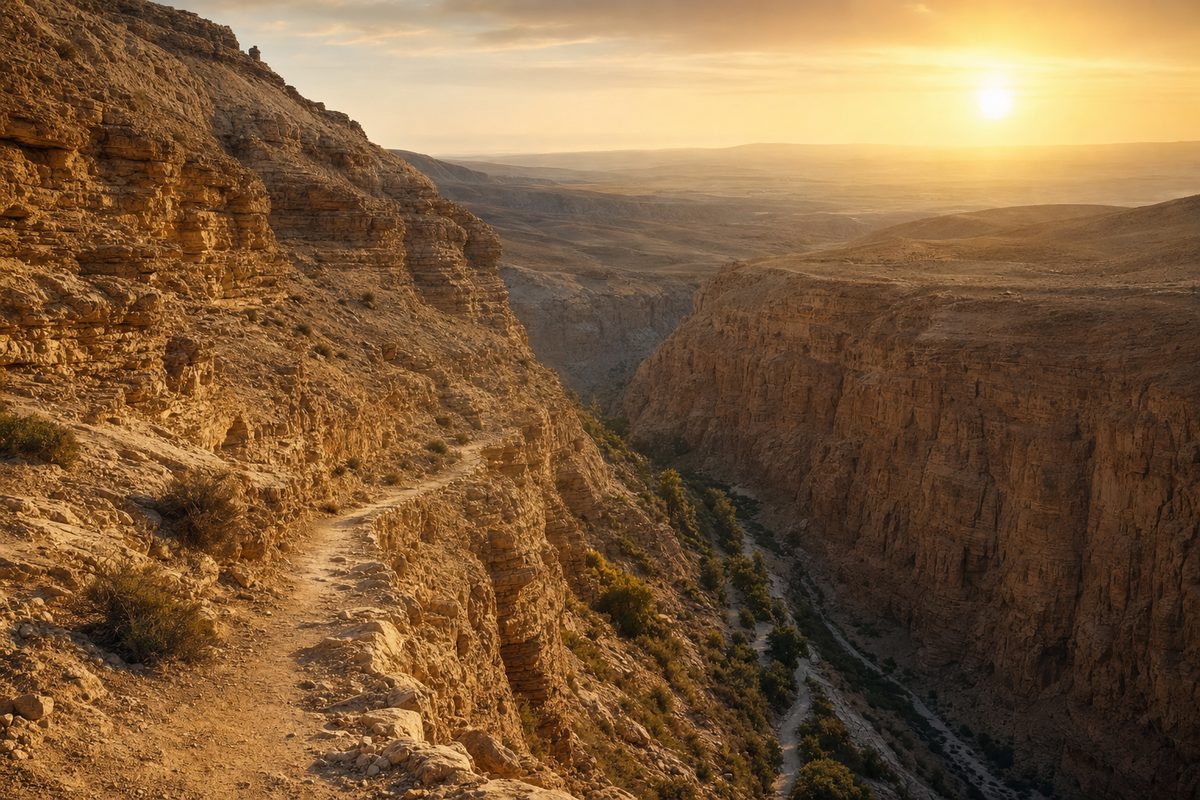
The location most likely to match what many people imagine when they hear “Bible Canyon” is Wadi Qelt, also known as Nahal Prat. It is a deep, rugged valley in the Judean Desert, extending eastward from the area near Jerusalem toward Jericho and the Jordan Valley. It lies in the region commonly described geographically as the West Bank or the biblical Judean wilderness.
Wadi Qelt contains steep cliffs, desert paths, springs, caves, and a seasonal stream. Its landscape helps modern readers appreciate how difficult and dangerous travel could be in biblical times. Jerusalem stands in the hill country, while Jericho lies far below it near the Jordan River and the Dead Sea. The journey between the two involved a significant descent through exposed wilderness terrain.
Jesus placed the parable of the good Samaritan on this road:
“A man was going down from Jerusalem to Jericho, and he fell among robbers” (Luke 10:30).
The phrase “going down” is geographically precise. Jerusalem sits at an elevation of roughly 2,500 feet, or 760 meters, above sea level, while Jericho is more than 800 feet, or 250 meters, below sea level. Travelers descended dramatically over a relatively short distance.
Wadi Qelt parallels routes that connected Jerusalem and Jericho, so its scenery is often used to illustrate the setting of Jesus’ parable. Yet Scripture does not say that the injured traveler was attacked at a particular point in Wadi Qelt. The parable presents a realistic road and recognizable danger, but it does not provide coordinates for the event. In fact, because it is a parable, the story’s central concern is not locating the precise bend in the road. Jesus was revealing what love for one’s neighbor looks like.
The Samaritan saw a wounded man, had compassion, approached him, treated his wounds, transported him to safety, and paid for his care. The priest and Levite saw the same need but passed by. Biblical geography makes the scene vivid, yet Christ’s command carries the greater weight: “You go, and do likewise” (Luke 10:37).
Wadi Qelt has also been proposed as a possible setting for the brook Cherith, where God sustained Elijah during a drought. First Kings records:
“You shall drink from the brook, and I have commanded the ravens to feed you there” (1 Kings 17:4).
The exact location of Cherith remains uncertain. Some scholars place it east of the Jordan, while others have suggested a site in the Judean wilderness. Wadi Qelt should not be presented as the proven answer. This is a helpful example of the difference between a possible identification and an established biblical location.
Today, Wadi Qelt is also known for St. George’s Monastery, built dramatically into its cliffs. The monastery is historically significant, but it dates from the Christian era long after the events of the Old Testament and the ministry of Jesus. Its presence does not turn the entire valley into a place called Bible Canyon.
Other Canyon-Like Places in the Bible
Wadi Qelt is not the only rugged valley that helps illuminate Scripture. The biblical lands contain many gorges, ravines, and wilderness strongholds. Several deserve attention when asking where a biblical canyon might be located.
En Gedi is an oasis on the western side of the Dead Sea in modern Israel. Its cliffs, caves, springs, and ravines provided a natural refuge. David hid in the strongholds of En Gedi while Saul pursued him (1 Samuel 23:29). Saul later entered a cave, unaware that David and his men were farther inside. David had the opportunity to kill Saul but refused to seize the kingdom through violence against the man who had been anointed king.
David said, “I will not put out my hand against my lord, for he is the Lord’s anointed” (1 Samuel 24:10). En Gedi’s landscape helps us feel the tension of that moment. The caves offered concealment, while the surrounding wilderness made escape difficult. Yet the passage is ultimately about David’s fear of God, restraint, and willingness to leave justice in the Lord’s hands.
The Arnon Gorge, known today as Wadi Mujib, is in modern Jordan and empties into the eastern side of the Dead Sea. In the Old Testament, the Arnon marked an important territorial boundary. Numbers 21:13 describes it as the border of Moab, and Deuteronomy refers to Israel’s movement through the surrounding region.
The gorge is deep and visually impressive, but its biblical importance is not merely scenic. It reminds readers that Israel’s journey unfolded among real kingdoms, borders, rivers, and contested territories. God’s acts of judgment and provision occurred in history, not in an imaginary religious world.
The Kidron Valley runs along the eastern side of Jerusalem, between the city and the Mount of Olives, before continuing into the Judean wilderness. David crossed the Kidron while fleeing from Absalom (2 Samuel 15:23). Centuries later, Jesus crossed it with His disciples on the way to the garden where He was arrested (John 18:1).
The valley therefore appears in moments of rejection and sorrow involving both David and the greater Son of David. The connection should not erase the differences between the passages, but it enriches our reading. David crossed while suffering because of turmoil connected with his own household and failures. Jesus crossed as the sinless King preparing to surrender Himself for sinners.
The Valley of Elah, southwest of Jerusalem, is broader than what most people would call a canyon, but it is another example of geography shaping a biblical account. Israel and the Philistines occupied opposing slopes when David confronted Goliath (1 Samuel 17). The valley floor became the place where the apparent weakness of a faithful shepherd exposed the powerlessness of a proud warrior before the living God.
These locations show why it is better to ask which biblical valley or gorge a person means rather than assume there is one official Bible Canyon.
How to Evaluate Claims About Biblical Locations
Maps, travel videos, social media posts, and tour guides sometimes attach confident biblical claims to impressive landscapes. Some identifications are well supported; others depend mostly on local tradition or speculation. A beautiful location can help us picture Scripture without being the proven site of a biblical event.
Begin with the biblical text itself. Notice the names of nearby cities, travel directions, tribal boundaries, bodies of water, elevations, and distances. Luke’s statement that a traveler went “down” from Jerusalem to Jericho, for example, agrees with the actual terrain. Such details show the writers’ familiarity with the land.
Next, distinguish between different levels of certainty. Jerusalem, Jericho, the Sea of Galilee, the Mount of Olives, and the Dead Sea are firmly identified. Other locations, including the precise position of Emmaus, the brook Cherith, and some stations in Israel’s wilderness journey, remain debated.
Archaeology, ancient records, preserved place-names, and geographic fit can strengthen an identification. Tradition may also be worth knowing, but tradition alone does not establish certainty. A responsible Bible teacher will say “possibly,” “traditionally identified as,” or “the exact location is unknown” when the available evidence requires humility.
It is also wise to distinguish between the location of a story and the meaning of the story. Knowing the road from Jerusalem to Jericho adds depth to the good Samaritan, but the purpose of the parable is not to make us experts in desert topography. Jesus was answering a man who wanted to define the limits of neighborly responsibility. The parable overturns that approach by showing costly mercy across social and religious hostility.
Similarly, seeing the caves of En Gedi can make David’s encounter with Saul more tangible. But the lasting question is whether we will trust God when obedience seems to delay the outcome we desire. David would not grasp the kingdom by sinful means, even though God had promised it to him.
Biblical geography serves Scripture best when it helps us hear the message more clearly rather than distracting us with unsupported claims. The land provides context, but God’s revealed Word remains our authority.
Let the Land Deepen Your Reading
So, where is Bible Canyon located? There is no single biblical site officially known by that name. If the phrase refers to a modern map label, its location cannot be determined without more regional information. If it refers more generally to a dramatic canyon associated with the Bible, Wadi Qelt in the Judean Desert near the Jerusalem-to-Jericho route is probably the strongest possibility.
Wadi Qelt is not named Bible Canyon in Scripture, and it should not be treated as the proven setting of every event associated with the Judean wilderness. It is better understood as one of several real landscapes that can help us visualize the world of the Bible. En Gedi, the Arnon Gorge, the Kidron Valley, and other rugged places also reveal how closely Scripture is connected to recognizable geography and history.
These places invite more than curiosity. The Jericho road confronts us with Christ’s call to merciful love. En Gedi shows the beauty of trusting God rather than obtaining a good end through sinful means. The Kidron Valley leads us toward Jesus, who willingly walked into betrayal, suffering, and death to save His people.
As you study biblical locations, keep an open Bible beside the map. Ask what the text clearly states, what history can responsibly confirm, and what remains uncertain. Then ask the more personal question: What does this passage reveal about God, and how should I respond to Him in faith and obedience?
StudyBible.io can be a helpful companion as you compare passages, explore historical context, and follow the geographic details that make the biblical story easier to understand.