What Was Jesus’ First Miracle? The Meaning of Water Into Wine
Jesus’ first recorded miracle was turning water into wine at the wedding in Cana. This sign revealed His glory, strengthened His disciples’ faith, and pointed toward the abundant grace and cleansing He came to bring.
Jesus’ first miracle recorded in the Bible was turning water into wine at a wedding in Cana of Galilee. The event is described in John 2:1–11, near the beginning of Jesus’ public ministry. John does not merely call it a miracle; he calls it the first of Jesus’ signs because it revealed who Jesus was and led His disciples to believe in Him.
At first, the setting may seem surprising. Jesus did not perform His first sign in the temple, before a king, or in front of a vast crowd. He performed it at a village wedding after the hosts ran out of wine. Yet this quiet act of power was far more than a solution to an embarrassing social problem. It displayed Jesus’ glory, pointed toward the abundant grace He came to bring, and introduced themes that unfold throughout the Gospel of John.
Understanding what happened at Cana helps us see that Jesus’ miracles were never displays of power for their own sake. They were signs pointing beyond themselves to His identity, His mission, and the faith-filled response He deserves.
What Happened at the Wedding in Cana?
John tells us that a wedding took place in Cana, a Galilean village not far from Nazareth. Mary, the mother of Jesus, was there, and Jesus and His disciples had also been invited. During the celebration, the wine ran out.
In the culture of that time, weddings were often large community celebrations that could continue for several days. Hospitality was a serious social responsibility, and running out of provisions would have brought public embarrassment upon the family. Mary became aware of the problem and said to Jesus, “They have no wine” (John 2:3).
Jesus answered, “Woman, what does this have to do with me? My hour has not yet come” (John 2:4). To modern ears, the word translated “woman” can sound cold. In its original setting, however, it was a respectful form of address. Jesus used the same term when He compassionately entrusted Mary to the care of the beloved disciple while hanging on the cross (John 19:26).
Even so, Jesus’ response established an important boundary. His ministry would not be directed by human expectations, not even those of His mother. He would act according to His Father’s will and timetable. The reference to His “hour” also introduces a major theme in John. Throughout the Gospel, Jesus’ hour ultimately points to His death, resurrection, and glorification (John 12:23; 13:1; 17:1).
Mary did not argue or demand a particular outcome. Instead, she told the servants, “Do whatever he tells you” (John 2:5). Her words express a posture of trust that remains deeply instructive. She brought the need to Jesus and left the response in His hands.
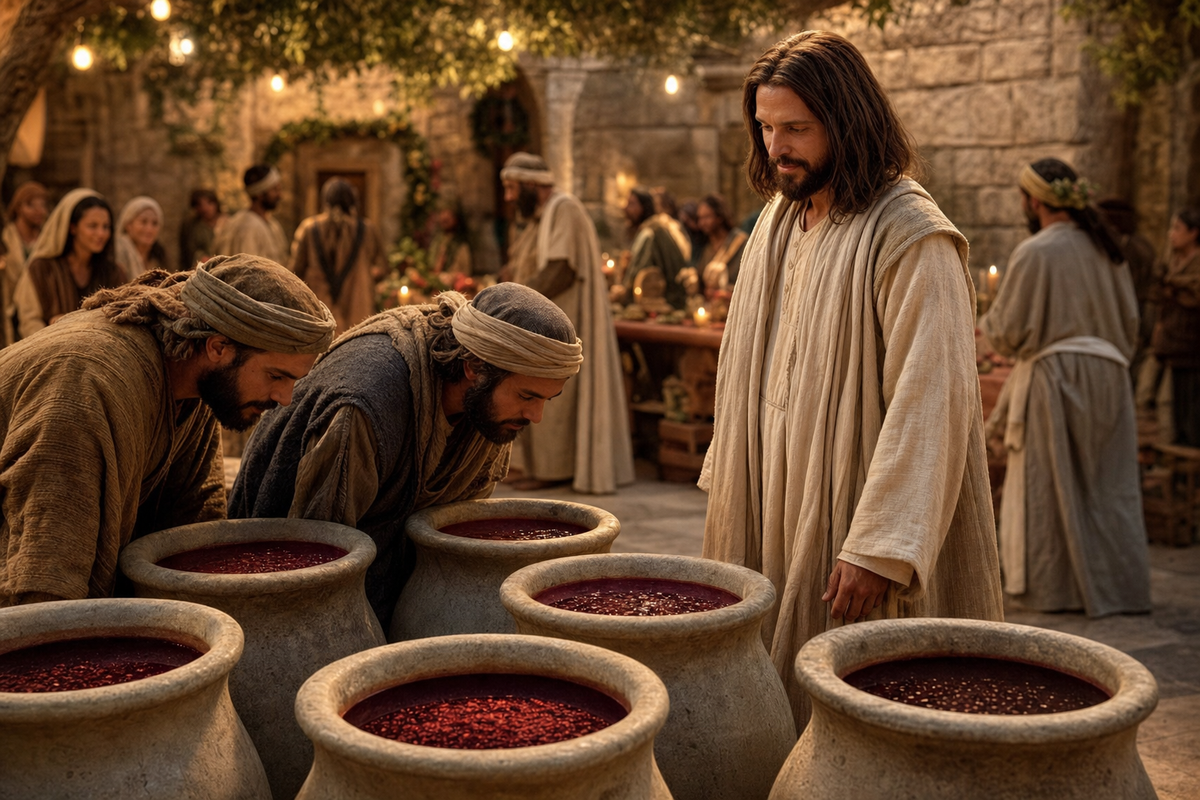
Nearby stood six large stone water jars used for Jewish purification practices. Each could hold roughly twenty to thirty gallons, meaning the total capacity may have been between 120 and 180 gallons. Jesus told the servants to fill the jars with water, and they filled them to the brim. He then instructed them to draw some out and take it to the master of the feast.
At some point, without spectacle or a public announcement, the water became wine.
The master of the feast tasted it without knowing where it had come from. He called the bridegroom and observed that people normally served the better wine first and brought out the lesser wine later, after the guests had been drinking. At this wedding, however, the best had been kept until that moment.
John concludes, “This, the first of his signs, Jesus did at Cana in Galilee, and manifested his glory. And his disciples believed in him” (John 2:11).
That final statement gives us John’s inspired explanation of the event. The miracle manifested Jesus’ glory, and it strengthened the faith of His disciples.
Why John Calls It Jesus’ First Sign
The clearest answer to the question “What was Jesus’ first miracle?” comes from John 2:11, which explicitly identifies the water becoming wine as the first of Jesus’ signs. John 4:54 later calls the healing of an official’s son the second sign Jesus performed after returning from Judea to Galilee.
Some later traditions and nonbiblical writings contain stories about supposed miracles Jesus performed as a child. These accounts are not part of the inspired Scriptures and should not be treated as reliable records of His life. The canonical Gospels do not describe Jesus performing childhood miracles. According to Scripture, the miracle at Cana marked the beginning of His public signs.
John’s preferred word is significant. A miracle emphasizes an extraordinary act of divine power. A sign is an act that also points to a deeper reality. Jesus’ signs were real works of power and mercy, but they were never meant to become spiritual entertainment. They revealed something about Him.
For example, when Jesus fed the five thousand, the sign pointed to Him as the Bread of Life (John 6:1–35). When He gave sight to a man born blind, the event displayed His identity as the Light of the World (John 9:1–7). When He raised Lazarus, He revealed Himself as the resurrection and the life (John 11:25, 38–44).
In the same way, the wine at Cana was not merely a convenient gift for a wedding party. Through it, Jesus began to reveal His glory as the Son of God who brings cleansing, joy, abundance, and new life.
The disciples already knew something about Jesus. In John 1, they had begun following Him and had heard remarkable testimony about His identity. Andrew called Him the Messiah. Philip spoke of the One promised in the Scriptures. Nathanael called Him the Son of God and King of Israel. Yet their faith still needed to deepen.
The Cana sign did not create faith in a vacuum. It confirmed and strengthened the disciples’ growing trust in Jesus. This pattern appears throughout John: people encounter Jesus, see His works, hear His words, and are called into a fuller faith in who He truly is.
John also warns that seeing miracles does not automatically produce saving faith. Some people were impressed by Jesus’ signs while remaining unwilling to entrust themselves to Him (John 2:23–25). Others desired His gifts without receiving His teaching (John 6:26–27). A sign fulfills its purpose when it leads us beyond amazement to trust, worship, and obedience.
What the Water and Wine Reveal About Jesus
The details John includes help us appreciate the meaning of the first sign. The six stone jars were associated with Jewish purification. Washing rituals reminded God’s people of the need to be clean, but outward washing could not cleanse a sinful heart. Jesus did not condemn the law God had given. Rather, His coming brought the fulfillment to which the law and its ceremonies pointed.
By using these purification jars in the sign, Jesus showed that something greater had arrived. The water associated with ceremonial cleansing became an abundance of excellent wine. The imagery points naturally toward the fullness and joy of the salvation Jesus brings.
The Old Testament sometimes used abundant wine as a picture of God’s promised restoration. Isaiah described the Lord preparing “a feast of rich food” and “a feast of well-aged wine” when He would swallow up death and wipe away tears (Isaiah 25:6–8). Amos pictured restored blessing with mountains dripping sweet wine (Amos 9:13–14). These promises should not be reduced to material prosperity. They portray the joy, restoration, and fellowship found under God’s saving reign.
At Cana, the promised King was present, although most of the guests did not recognize Him. The master of the feast knew the quality of the wine but did not know its source. The servants knew where it came from, and the disciples saw the glory behind it. Jesus quietly supplied what the household could not provide for itself.
The quantity also matters. Jesus did not produce a barely sufficient amount. He provided an extraordinary abundance. This does not teach that believers are promised effortless wealth, luxury, or freedom from hardship. Jesus Himself would walk the road of suffering, and He called His disciples to take up their crosses. The abundance at Cana points instead to the sufficiency of His grace and the greatness of the salvation found in Him.
The quality of the wine reinforces the same truth. The master of the feast declared that the bridegroom had kept the good wine until last. In the unfolding story of redemption, God had not failed to provide for His people before Christ. Yet in His Son, the fullness of God’s saving revelation had arrived. As John wrote earlier, “The law was given through Moses; grace and truth came through Jesus Christ” (John 1:17).
This verse does not set God’s law against His grace as if the law were evil. The law itself was a gracious gift. But it could expose sin without becoming the final cure for sin. Jesus came to accomplish what rituals and human effort could never accomplish. He would give Himself on the cross, shed His blood for sinners, rise from the dead, and bring all who believe into true cleansing and fellowship with God.
The setting of a wedding is meaningful as well. Scripture frequently uses marriage imagery to describe God’s covenant relationship with His people. Later in John, John the Baptist refers to Jesus as the bridegroom (John 3:29). The final book of the Bible looks toward the marriage supper of the Lamb (Revelation 19:6–9). We should not force every wedding detail into a hidden symbolic system, but the setting fits the larger biblical picture: Jesus is the promised Bridegroom who brings His people into the joy of God’s kingdom.
The passage also shows that Jesus was not detached from ordinary human life. He attended a wedding and acted within a moment of family and community need. His presence honors the goodness of marriage and shared celebration. At the same time, the Bible’s positive references to wine never excuse drunkenness, which Scripture clearly condemns (Ephesians 5:18). The point of Cana is not indulgence. It is the glory and generous sufficiency of Christ.
What Mary and the Servants Teach Us
Mary’s role in the story is sometimes misunderstood. She noticed the need and brought it to Jesus, but she did not perform the miracle, determine its timing, or command Jesus to act. Her most important recorded words in this scene direct attention away from herself and toward Him: “Do whatever he tells you.”
Those words capture the right response to Jesus. Faith does not attempt to control Him. It trusts His wisdom and submits to His word.
The servants model this obedience in a practical way. Jesus told them to fill the jars, and they filled them to the brim. He then told them to take a sample to the master of the feast. From their perspective, carrying water from purification jars to the person responsible for the banquet may have seemed confusing or risky. Yet they obeyed what Jesus said.
The passage does not tell us the precise instant when the water changed. The transformation could have occurred in the jars, as the servants drew it out, or while they carried it. John’s focus is not on the mechanics but on Jesus’ authority. No incantation, ceremony, or visible struggle was necessary. The created order responded to its Creator.
This does not mean that every act of obedience will lead to a dramatic miracle or that believers can secure a desired result by following the right steps. Cana is not a formula for getting God to grant our requests. It is a revelation of Jesus. Christian obedience rests not on a guarantee that circumstances will unfold as we prefer, but on the certainty that Christ is trustworthy.
Still, the servants remind us that we can obey Jesus even when we do not yet understand everything He is doing. His commands are not obstacles to joy; they are the path of faithful discipleship. We may bring our needs honestly to Him, listen carefully to His Word, and entrust the outcome to His wisdom.
The story also encourages those who feel that their concerns are too ordinary to matter. Running out of wine at a wedding was not a national crisis. Nevertheless, Jesus chose to act there. Scripture does not promise that He will remove every embarrassment or prevent every disappointment. It does show that His glory can be revealed in places that seem small, private, and unnoticed.
The Lasting Meaning of Jesus’ First Miracle
Jesus’ first miracle was the turning of water into wine, but the deepest question is not simply what He did. It is what the sign reveals about who He is.
Jesus is the Son whose authority reaches into creation itself. He is the fulfillment of God’s saving promises. He is the source of true cleansing and kingdom joy. He supplies what human beings cannot produce for themselves, and His provision is better than anything we could secure through our own effort.
The sign also points forward. Jesus said His hour had not yet come, but that hour eventually did come. At the cross, He bore the judgment sinners deserve. In His resurrection, He conquered death. The glory briefly displayed at Cana would be revealed most fully through His sacrificial death and victorious resurrection.
This keeps us from reading the passage as a simple promise that Jesus will turn every shortage into material abundance. The greatest gift at Cana was not the wine. It was the presence of Jesus. The greatest need He came to meet was not a temporary lack at a wedding but humanity’s separation from God through sin.
When reading John 2:1–11, notice who recognizes what has happened. Many guests enjoy the gift without knowing its source. The master of the feast recognizes its quality but not the One who provided it. The servants know where it came from. The disciples see the sign, behold Jesus’ glory, and believe in Him.
That progression invites personal reflection. It is possible to enjoy God’s gifts without seeking God Himself. It is possible to admire Jesus’ works without submitting to His identity and words. John calls us to something deeper: to see the signs, listen to the Son, and believe.
A helpful next step is to read the Cana account slowly in its context, beginning with John 1 and continuing through John 3. Pay attention to the titles given to Jesus, the repeated references to testimony and belief, and the contrast between outward religion and the new life only Christ can give. Ask not only what the miracle meant to the people at the wedding, but what John wants every reader to understand about Jesus.
The first sign at Cana quietly declared that the promised Savior had come. His glory was present in an ordinary village, His grace was sufficient for a need no one else could meet, and His disciples were invited to trust Him more deeply. That same Jesus remains worthy of faith today—not merely because of what He can give, but because of who He is.
For a deeper study of John 2 and its place within the Gospel, StudyBible.io can help you explore the passage, related themes, and cross-references while keeping Scripture at the center.