
What Did Jesus Eat? Foods Mentioned in the Bible and What His Meals Mean
Jesus ate ordinary first-century Jewish foods, including bread and fish, and shared Passover meals with His disciples. His meals also revealed His compassion, saving mission, and identity as the Bread of Life.
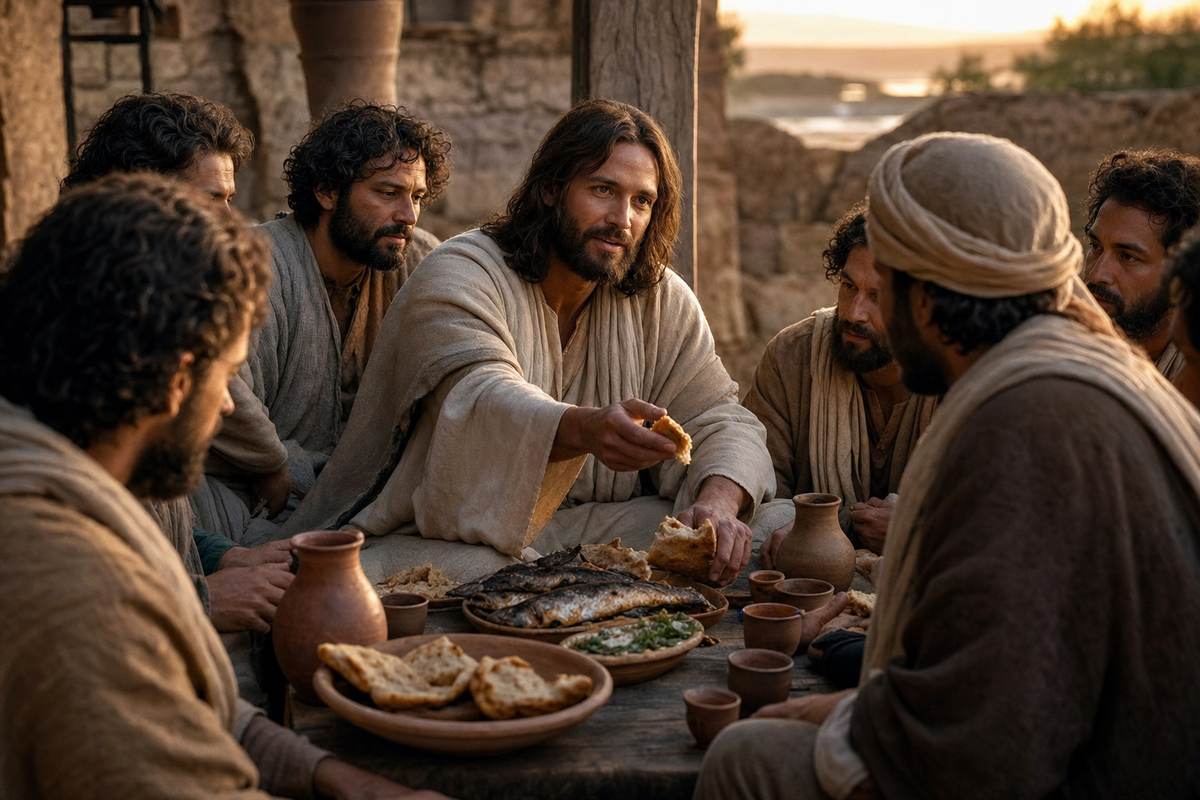
When we ask, “What did Jesus eat?” we are asking a question that is both ordinary and deeply meaningful. Jesus lived in a real place, among real people, and shared the everyday rhythms of human life. He became hungry, sat at tables, attended feasts, gave thanks for food, and ate with family, friends, religious leaders, and social outcasts.
The Gospels do not provide a complete daily menu for Jesus. They were written to reveal who He is and what He came to accomplish, not to record every detail of His diet. Still, they mention several foods Jesus ate or served, including bread, fish, and Passover foods. They also place Him within the food culture of first-century Galilee and Judea, where people commonly ate grains, olives, grapes, figs, legumes, vegetables, dairy products, and fish.
The clearest answer is that Jesus ate the ordinary foods of a first-century Jewish man while observing the biblical customs of His people. Yet His meals were rarely only about food. Around the table, Jesus revealed God’s generosity, welcomed sinners, confronted self-righteousness, and pointed people toward the kingdom of God.
Bread, Fish, and Everyday Food
Bread was the central food of daily life in the world of Jesus. It could be made from wheat, though barley was less expensive and commonly eaten by poorer families. Bread appears throughout the Gospels because it was a basic part of nearly every meal.
Jesus ate bread at the Last Supper. Matthew records, “Now as they were eating, Jesus took bread, and after blessing it broke it and gave it to the disciples” (Matthew 26:26). Luke also tells us that the risen Jesus was recognized by two disciples in Emmaus when He took bread, blessed it, broke it, and gave it to them (Luke 24:30–31).
Bread was also central to two of Jesus’ most famous miracles. When He fed five thousand men, besides women and children, the available meal consisted of five barley loaves and two fish (John 6:9). Jesus gave thanks and distributed the food until everyone had enough. He later fed another large crowd with seven loaves and a few small fish (Matthew 15:34–38).
These passages do not always state directly that Jesus ate the food Himself. Their emphasis is on His compassion and provision. Nevertheless, bread was unquestionably part of His life and meals. It also became one of His clearest spiritual images. After feeding the crowd, Jesus declared, “I am the bread of life; whoever comes to me shall not hunger, and whoever believes in me shall never thirst” (John 6:35).
Jesus was not saying that physical hunger is unimportant. He had just fed hungry people. Instead, He showed that even a full stomach cannot satisfy the deepest need of the human heart. Bread sustains the body for a time, but Christ gives eternal life.
Fish was another important food, especially in Galilee. Several of Jesus’ disciples were fishermen, and towns around the Sea of Galilee depended on fishing and fish trading. Fish could be eaten fresh, dried, salted, or cooked over a fire.
The most explicit account of Jesus eating a particular food comes after His resurrection. When the disciples wondered whether they were seeing a spirit, Jesus showed them His hands and feet and invited them to touch Him. Luke then writes, “They gave him a piece of broiled fish, and he took it and ate before them” (Luke 24:42–43).
This simple meal carries great theological weight. Jesus did not rise merely as an idea, memory, or disembodied spirit. He rose bodily. His eating demonstrated the physical reality of the resurrection.
John 21 records another post-resurrection meal involving bread and fish. The disciples came ashore after a night of fishing and found Jesus beside a charcoal fire, with fish laid on it and bread nearby. Jesus said, “Come and have breakfast” (John 21:12). The passage emphasizes that He gave the disciples bread and fish. It does not explicitly say that He ate on this occasion, but He clearly prepared and shared the meal with them.
Even after conquering death, Jesus served His disciples breakfast. The risen Lord met tired, discouraged men with truth, restoration, and a meal.
Passover Foods and Jewish Faithfulness
Jesus was Jewish, born under the law and raised within Israel’s covenant life. His family observed the appointed feasts. Luke tells us that His parents went to Jerusalem every year for Passover (Luke 2:41–42), and the Gospels later describe Jesus attending Passover and other Jewish festivals.
This means Jesus’ eating habits were shaped by the food laws given to Israel. Scripture does not record Him eating pork, shellfish, or other foods classified as unclean under the Mosaic covenant. Nothing in the Gospels portrays Jesus as personally violating the law. Rather, He fulfilled it perfectly.
Jesus’ disciples prepared a Passover meal shortly before His crucifixion. Passover meals centered on God’s deliverance of Israel from slavery in Egypt. Exodus 12 identifies roasted lamb, unleavened bread, and bitter herbs as key elements of the original Passover meal.
Because the Gospels describe Jesus’ final meal with His disciples as a Passover meal, it is reasonable to think that customary Passover foods were present. However, readers should distinguish between what is likely and what the text explicitly says. The Gospel accounts specifically mention bread and the cup, but they do not directly state that Jesus ate lamb during that meal.
The bread would have been unleavened, reflecting the haste with which Israel left Egypt. Jesus took that bread and gave it a deeper fulfillment in His own sacrifice: “Take, eat; this is my body” (Matthew 26:26). He then took the cup and said, “Drink of it, all of you, for this is my blood of the covenant, which is poured out for many for the forgiveness of sins” (Matthew 26:27–28).
Jesus also drank wine. Wine was a normal part of ancient Jewish meals and celebrations, commonly diluted with water. At the wedding in Cana, Jesus miraculously turned water into wine when the supply ran out (John 2:1–11). At the Last Supper, He shared the cup with His disciples and spoke of drinking again in His Father’s kingdom (Matthew 26:29).
This does not make drunkenness acceptable. Scripture consistently condemns intoxication and the loss of self-control it brings. Jesus’ use of wine belongs within the biblical setting of meals, celebration, covenant, and thanksgiving—not excess.
At the cross, Jesus was offered wine mixed with a bitter or numbing substance, but after tasting it, He would not drink it (Matthew 27:34; Mark 15:23). Later, shortly before His death, He received sour wine (John 19:28–30). These details emphasize that He consciously endured the suffering before Him and completed the work the Father had given Him.
What Jesus Probably Ate
The Bible gives us firm details about some foods, but historical context can help us understand the wider diet Jesus probably knew. This requires humility. A food may have been common in Galilee without being specifically identified as something Jesus ate.
A typical first-century Jewish diet in Galilee and Judea was built around bread, olive oil, vegetables, legumes, fruit, and, where available, fish or other meat. Lentils, beans, onions, cucumbers, and leafy plants were familiar foods. Grapes, figs, dates, and pomegranates grew in the region. Olives and olive oil were used regularly, while milk products such as cheese or yogurt could also be part of ordinary life.
Jesus referred to several of these foods and crops in His teaching. He spoke of figs, grapes, wheat, mustard, salt, eggs, fish, and bread. These images worked because His listeners knew them from fields, kitchens, markets, and family tables.
Figs appear several times in the Gospels, though Scripture does not explicitly say Jesus ate one. He approached a fig tree looking for fruit but found none (Mark 11:12–14). Grapes and vineyards appear frequently in His parables, but the Gospels do not give us a scene of Jesus eating grapes. Olive oil was widely used for cooking, lamps, medicine, grooming, and religious purposes, yet there is no verse that simply says, “Jesus ate olives.”
Meat was available but was less likely to be an everyday food for an ordinary family. Lamb was associated especially with Passover, while goats, cattle, and permitted birds could also be eaten. Fish was more accessible in the Galilean setting and receives much more attention in the Gospel narratives.
Some popular descriptions of the “diet of Jesus” go beyond what Scripture supports. They may confidently claim that Jesus regularly ate a particular modern-style menu or recommend a branded eating plan based on biblical foods. The Bible does not provide enough evidence for that. We can reconstruct a general historical picture, but we should not turn probability into certainty.
Scripture is much more interested in Jesus’ identity than in nutritional details. It tells us enough to show His genuine humanity without distracting from the purpose of His life. Jesus ate because the eternal Son truly took on human flesh. He did not merely appear human. He experienced hunger after fasting in the wilderness (Matthew 4:2), thirst at Jacob’s well (John 4:7), weariness on the road, and physical suffering on the cross.
The fact that Jesus needed food should deepen our wonder at the incarnation. The One through whom all things were created willingly entered a body that could hunger. The One who provides seed for the sower and bread for food accepted bread from human hands.
Why Jesus’ Meals Mattered
If we only ask what was on Jesus’ plate, we may miss what happened around His table. The Gospels repeatedly use meals to reveal the character of His mission.
Jesus ate with tax collectors and sinners. After calling Matthew, He reclined at a meal where many tax collectors and others joined Him and His disciples. Religious leaders treated this as scandalous, but Jesus answered, “Those who are well have no need of a physician, but those who are sick” (Matthew 9:12).
Jesus did not share meals with sinners because He approved of sin. He came near because He came to save. His fellowship offered mercy and called people to repentance. At His table, grace was not sentimental acceptance; it was the presence of the Physician among those who needed healing.
Jesus also dined with Pharisees. In Luke 7, a Pharisee invited Him to eat, and a sinful woman entered, wept at His feet, and anointed them. The host silently judged both the woman and Jesus. But Christ exposed the man’s loveless self-righteousness and declared forgiveness to the woman who came in faith.
In Luke 14, another meal at a Pharisee’s house became the setting for teaching about humility and hospitality. Jesus told His hearers not merely to invite people who could repay them, but to welcome those who could not return the favor. His table teaching challenged the human instinct to use generosity for status.
Jesus ate in the home of Zacchaeus, a wealthy tax collector whose life had been marked by injustice. The crowd complained, but the encounter produced visible repentance. Zacchaeus promised restitution and generosity, and Jesus declared, “Today salvation has come to this house” (Luke 19:9).
These meals show that Jesus’ welcome transforms those who receive Him. He does not wait for morally perfect people to approach Him, because no such people exist. Yet He also does not leave people unchanged. Grace brings forgiveness, and forgiveness begins reshaping how a person lives.
Jesus was even criticized simply for eating and drinking. He contrasted His public ministry with the stricter lifestyle of John the Baptist and said, “The Son of Man came eating and drinking, and you say, ‘Look at him! A glutton and a drunkard, a friend of tax collectors and sinners!’” (Luke 7:34). The accusations were false, but the title “friend of sinners” revealed something true about His saving mission.
Food also became a picture of God’s coming kingdom. Jesus compared the kingdom to a wedding feast and spoke of people coming from east and west to sit at the table with Abraham, Isaac, and Jacob (Matthew 8:11). The Bible’s final vision includes the marriage supper of the Lamb (Revelation 19:9). The story moves toward redeemed fellowship with God, not lonely spirituality.
Receiving Food With Gratitude
Jesus’ example gives us a faithful way to think about our own meals. He received food with thanksgiving. Before distributing bread and fish to the crowds, He gave thanks. At the Last Supper, He blessed the bread and gave thanks for the cup. Food was not treated as an entitlement but as a gift from the Father.
This invites us to recover gratitude in ordinary life. Giving thanks before a meal need not be an empty ritual. It can be a quiet confession that our lives are sustained by God’s generosity. Every meal depends on soil, rain, labor, provision, and countless mercies we did not create for ourselves.
Jesus also teaches us to notice hungry people. When the disciples wanted to send the crowd away to find food, He said, “You give them something to eat” (Mark 6:37). Only Jesus could multiply the loaves, but He involved His disciples in distributing what He provided. Christian gratitude should open our hands, not close them.
At the same time, Jesus warned against living as though food were our highest good. During His temptation, He answered Satan, “Man shall not live by bread alone, but by every word that comes from the mouth of God” (Matthew 4:4). We need food, but we need God more. A carefully managed diet cannot reconcile us to Him, cleanse our guilt, or give eternal life.
So, what did Jesus eat? The Gospels clearly connect Him with bread and fish, explicitly show Him eating broiled fish after His resurrection, and describe Him sharing the bread and cup at Passover. He likely ate many other ordinary foods available to Jewish people in first-century Galilee and Judea, but Scripture does not give us a complete menu.
The deeper invitation is to see what His meals reveal. Jesus is truly human, full of compassion, generous toward the hungry, and willing to welcome sinners who come to Him. He is also the Bread of Life, the One who gave His body and blood so that all who believe in Him may be forgiven and live.
The next time you read a Gospel meal scene, slow down and notice who is present, who feels excluded, what Jesus says, and how people respond to Him. The food matters, but the One at the table matters infinitely more. StudyBible.io can be a helpful companion as you trace these meal scenes and explore their biblical setting more deeply.