
How Heavy Was the Cross of Jesus? What the Bible and History Tell Us
Jesus likely carried a Roman crossbeam weighing about 75 to 125 pounds, though Scripture does not reveal an exact figure. The greater truth is that He willingly endured the cross to bear sin and accomplish redemption.
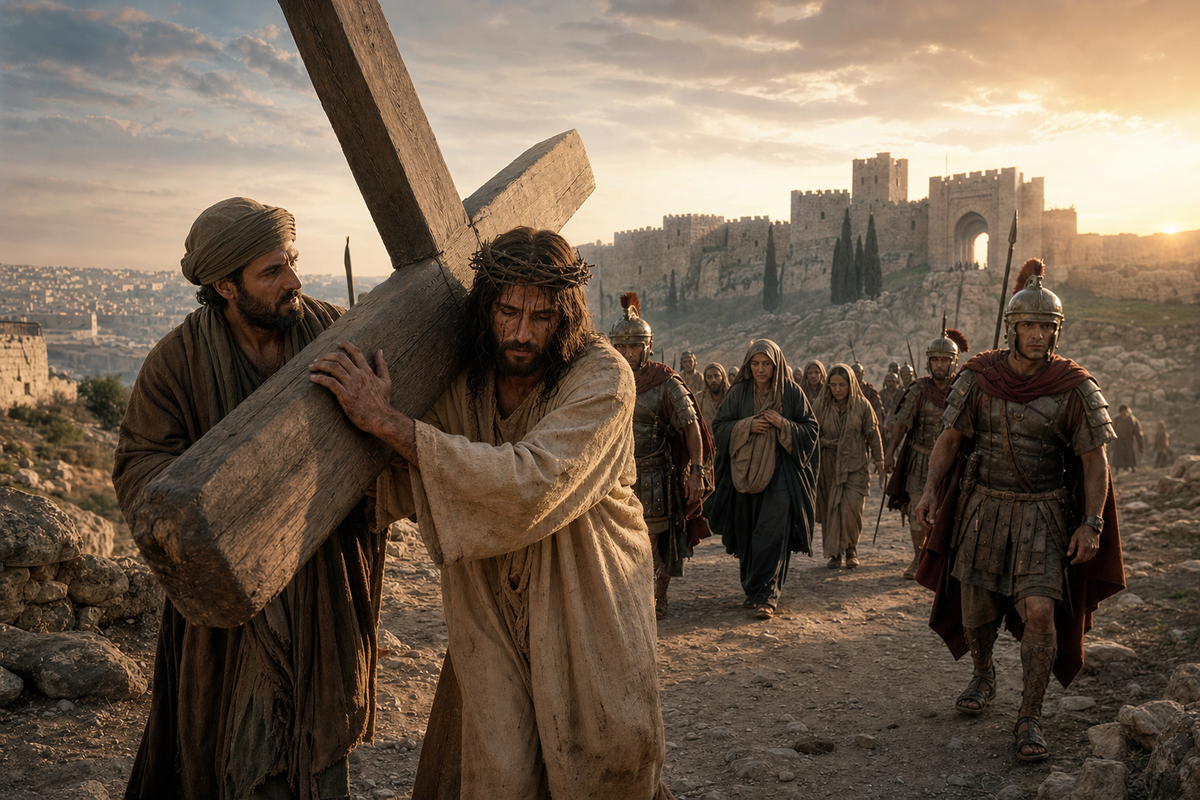
How heavy was the cross of Jesus? The Bible does not give its exact weight, so any precise number should be treated cautiously. Historical evidence about Roman crucifixion, however, helps us make a reasonable estimate.
Jesus may have carried a horizontal crossbeam weighing roughly 75 to 125 pounds, rather than an entire cross. A complete Roman cross could have weighed more than 200 pounds, perhaps considerably more depending on its size and wood. Yet even these figures are estimates, not facts recorded in Scripture.
The distinction matters because many familiar paintings and films show Jesus carrying a fully assembled cross. That image is possible, but it may not reflect the most common Roman practice. More importantly, the physical weight is only one part of what Jesus endured. Before reaching Golgotha, He had been beaten, scourged, mocked, deprived of rest, and subjected to severe blood loss. The crossbeam was crushing not merely because it was heavy, but because Jesus carried it after prolonged physical and emotional suffering.
The Gospel accounts lead us beyond curiosity about a number. They show the Son of God willingly walking toward the death through which He would save His people from sin.
What Did Jesus Actually Carry?
All four Gospels describe Jesus being led away to be crucified, but they do not identify the cross’s dimensions, type of wood, or weight. John specifically says, “And he bearing his cross went forth into a place called the place of a skull” (John 19:17). Matthew, Mark, and Luke also tell us that Roman soldiers compelled Simon of Cyrene to carry it.
Matthew records, “And as they came out, they found a man of Cyrene, Simon by name: him they compelled to bear his cross” (Matthew 27:32). Mark 15:21 and Luke 23:26 provide similar accounts.
These descriptions are not necessarily contradictory. John may be telling us that Jesus began the journey carrying the cross, while the other Gospel writers focus on what happened after the soldiers forced Simon to take it. Luke says that the soldiers laid the cross on Simon and made him carry it behind Jesus, which strongly suggests that Jesus had carried it for at least part of the journey.
The Greek word translated “cross,” stauros, could refer to the instrument of crucifixion as a whole. It did not always distinguish between a complete cross and one of its components. Consequently, saying that Jesus carried His cross does not require us to conclude that He carried an already assembled structure.
Roman crucifixion practices varied across regions and periods, but condemned prisoners were commonly made to carry the horizontal crossbeam, often called the patibulum. The vertical post may already have been fixed at the execution site. Once there, the victim would be attached to the crossbeam, which was then raised and secured to the upright post.
If that was the procedure used in Jesus’ crucifixion, He likely carried the crossbeam rather than the entire cross. Scripture does not settle the question conclusively, however, and we should not turn a historically informed possibility into a biblical certainty.
The Gospel writers were not trying to satisfy every modern question about Roman execution. Their emphasis was on the identity of the One being crucified and the meaning of His death. Jesus, condemned though innocent, was taken outside the city and put to death as a criminal in fulfillment of God’s saving purpose.
The Most Reasonable Weight Estimate
Estimates for a Roman crossbeam commonly range from approximately 75 to 125 pounds, or about 34 to 57 kilograms. Some estimates are higher, depending on the crossbeam’s length, thickness, and type of wood. Because no physical remains of Jesus’ particular cross have been identified, its weight cannot be calculated with confidence.
A full cross containing both a vertical post and horizontal beam could have weighed more than 200 pounds, with some estimates reaching 300 pounds or more. The exact figure would depend greatly on construction. Wood is not uniform, and Roman execution instruments were probably functional rather than standardized according to a single design.
This makes the frequently repeated claim that Jesus’ cross weighed one exact amount—such as 165, 250, or 300 pounds—far more certain than the evidence allows. Those numbers may be possible estimates, but they are not stated in the Bible or confirmed by a surviving record of the cross.
The most responsible answer is therefore straightforward: Jesus probably carried a crossbeam weighing somewhere around 75 to 125 pounds, but we cannot know the exact weight. If He carried the entire cross, the burden would have been substantially heavier, though that scenario may be less consistent with common Roman practice.
Even the lower end of the estimated range represents an enormous load. A wooden beam of that weight would be awkward and difficult to balance under normal conditions. Jesus was not carrying it under normal conditions.
He had spent an agonizing night under arrest. He had been questioned before Jewish leaders and brought before Pilate. Soldiers struck Him, placed a crown of thorns on His head, mocked Him, and scourged Him. Roman scourging could cause deep tissue damage, extensive bleeding, shock, and extreme weakness. The Gospels do not describe every medical effect, but they clearly present Jesus as suffering severe abuse before the journey to Golgotha began.
This context helps explain why Simon was compelled to carry the cross. The text does not explicitly say that Jesus collapsed, so that familiar scene should not be presented as though Scripture directly records it. Nevertheless, the soldiers’ decision to transfer the burden to Simon strongly indicates that Jesus had become unable, or was judged unlikely, to carry it all the way to the execution site.
The physical weight was real. So were the rough streets, public humiliation, open wounds, exhaustion, and certainty of the death ahead. The restrained language of the Gospels does not diminish the horror. Instead, it directs our attention to Jesus’ willing obedience within it.
Why Simon of Cyrene Carried the Cross
Simon of Cyrene appears suddenly in the story. Cyrene was a city in North Africa, in the region of modern Libya, with a significant Jewish population. Mark identifies Simon as the father of Alexander and Rufus, perhaps because those men were known to Mark’s original readers (Mark 15:21).
Simon does not volunteer. The soldiers compel him. As representatives of Roman authority, they could force a passerby into temporary service. Simon had apparently come in from the country when he was seized and placed behind Jesus with the cross.
We should be cautious about inventing the rest of Simon’s story. Scripture does not tell us what he thought, whether he became a believer that day, or how this encounter affected his family. Romans 16:13 mentions a Christian named Rufus, but the Bible does not explicitly confirm that he was Simon’s son. It is an intriguing possibility, not a certainty.
What the text does show is striking enough: another man physically carried the wood on which Jesus would die, but only Jesus could accomplish what His death achieved. Simon could share the burden of the beam for a distance. He could not bear sin, reconcile sinners to God, or offer himself as the spotless sacrifice.
Jesus had repeatedly told His disciples that He was going to suffer and die. He said that the Son of Man came “to give his life a ransom for many” (Mark 10:45). At His arrest, He did not lose control of His mission. When Peter attempted to defend Him, Jesus answered, “The cup which my Father hath given me, shall I not drink it?” (John 18:11).
Simon’s presence therefore does not mean that Jesus was unwilling to continue toward the cross. It reveals the severity of His physical suffering while the larger narrative reveals His steadfast obedience. Jesus went to Golgotha because He had committed Himself to doing the Father’s will and laying down His life for His sheep.
Isaiah had spoken centuries earlier of the Servant who would suffer for others: “He was wounded for our transgressions, he was bruised for our iniquities” (Isaiah 53:5). The deepest burden Jesus bore cannot be measured in pounds. On the cross, the sinless One endured judgment as the substitute for sinners.
That truth requires careful wording. Jesus did not become morally sinful or cease to be the beloved Son. Rather, He bore the penalty of sin as the righteous substitute. As Peter writes, “Who his own self bare our sins in his own body on the tree” (1 Peter 2:24). The cross was not a tragic interruption of Jesus’ ministry. It stood at the center of God’s plan of redemption.
The Greater Weight Jesus Bore
Questions about the weight of Jesus’ cross often arise from a sincere desire to understand His suffering. Historical details can help us see the crucifixion as a real event involving real wood, real pain, and a real Roman execution. Christianity is not built on a vague symbol detached from history. Jesus was crucified under the authority of Pontius Pilate, and His death took place in the physical world.
Yet the Gospel writers want us to see more than physical suffering. Many people suffered under Roman crucifixion, horrifying as it was. Jesus’ death is unique because of who He is, why He died, and what His death accomplished.
Jesus was not executed for wrongdoing He had committed. Pilate repeatedly acknowledged that he found no basis for a charge deserving death. One criminal crucified beside Jesus also recognized His innocence, saying, “This man hath done nothing amiss” (Luke 23:41). Even as human courts failed, God was accomplishing His redemptive purpose.
Paul explains, “Christ died for our sins according to the scriptures” (1 Corinthians 15:3). He also writes, “For he hath made him to be sin for us, who knew no sin; that we might be made the righteousness of God in him” (2 Corinthians 5:21). These passages take us to the heart of the cross. Jesus’ death was sacrificial and substitutionary: the righteous One died on behalf of the unrighteous to bring us to God (1 Peter 3:18).
This does not make the cross less brutal. It makes Jesus’ willingness more astonishing. He knew what lay ahead. In Gethsemane, He experienced profound anguish and prayed that, if possible, the cup might pass from Him. Yet He submitted Himself to the Father: “Nevertheless not my will, but thine, be done” (Luke 22:42).
The cross therefore displays both the seriousness of sin and the greatness of God’s love. Sin is not a minor flaw that can be corrected through greater effort. It separates humanity from a holy God and brings judgment. At the same time, God did not leave sinners without hope. “God commendeth his love toward us, in that, while we were yet sinners, Christ died for us” (Romans 5:8).
When we focus only on how many pounds Jesus carried, we risk reducing the cross to a feat of endurance. Jesus certainly endured extraordinary physical torment, but salvation does not rest on His ability to carry heavy timber. It rests on His faithful obedience, atoning death, and victorious resurrection.
The empty tomb is essential to the message. The One who carried the cross and was crucified upon it rose bodily from the dead. The cross reveals the cost of redemption; the resurrection declares Christ’s victory over sin and death. Christians do not worship a defeated martyr but the risen Lord.
What It Means to Take Up Your Cross
Jesus’ physical journey toward Golgotha also gives depth to His call to discipleship. Before His crucifixion, He told His followers, “If any man will come after me, let him deny himself, and take up his cross, and follow me” (Matthew 16:24).
Modern speech sometimes uses “my cross to bear” for any inconvenience, difficult relationship, illness, or frustrating circumstance. Such hardships may be genuinely painful, and believers can bring all of them to God. But Jesus’ original hearers would have understood the cross as an instrument of shame, suffering, and death.
Taking up one’s cross means following Jesus with a willingness to surrender self-rule, endure rejection, and remain faithful regardless of the cost. It does not mean seeking suffering, tolerating preventable abuse, or trying to earn salvation through pain. Christ’s atoning cross is unique and sufficient. Disciples carry a cross not to save themselves, but because they already belong to the Savior who gave Himself for them.
This call reaches beyond outward religious interest. It asks whether Jesus is truly Lord over our loyalties, ambitions, habits, relationships, and decisions. Self-denial is not the destruction of the value God has given us. It is the refusal to treat our desires as the highest authority. We follow Christ because He alone has the words of eternal life.
The weight Jesus carried can therefore move us from historical curiosity toward worship and obedience. We may not know whether His crossbeam weighed 80 pounds, 100 pounds, or more. We do know that He endured the cross while despising its shame and is now seated at the right hand of God (Hebrews 12:2).
Hebrews invites believers to respond by laying aside sin and running with endurance while “looking unto Jesus” (Hebrews 12:2). That is a fitting place for this question to lead. The goal is not merely to picture how difficult the walk to Golgotha was, but to see more clearly the Savior who made that walk willingly.
The most historically reasonable estimate is that Jesus carried a crossbeam weighing approximately 75 to 125 pounds until Simon of Cyrene was forced to carry it. The complete cross may have weighed more than 200 pounds, but Scripture does not provide an exact number, and historical practices do not allow absolute certainty.
What Scripture does reveal with certainty is far more important. Jesus bore suffering without turning away from the Father’s will. He gave His life for sinners, was buried, and rose again. The wooden burden was immense, but the saving significance of His cross cannot be measured.
As you read the crucifixion accounts in Matthew 27, Mark 15, Luke 23, and John 19, take time to notice both their differences in emphasis and their united testimony. Jesus Christ, the innocent Son of God, willingly went to the cross so that all who trust in Him might receive forgiveness, reconciliation, and eternal life.
For a deeper comparison of these passages and their historical context, StudyBible.io can serve as a helpful companion as you study the road to the cross and the hope of the resurrection.