Are God and Jesus the Same? What the Bible Really Teaches
Jesus is fully God, but He is not God the Father. Scripture reveals one God eternally existing as three distinct persons: the Father, the Son, and the Holy Spirit.
The short answer is both yes and no—but not because the Bible contradicts itself. Jesus is fully God, but Jesus is not God the Father. He shares the one divine nature with the Father and the Holy Spirit, yet He is a distinct person from both.
That distinction matters. If we say Jesus is less than God, we deny what Scripture reveals about Him. If we say Jesus and the Father are the same person, we ignore the many passages in which they speak to one another, love one another, and act in relationship with one another.
The Christian understanding of God is often summarized by the word Trinity: there is one God who eternally exists as three distinct persons—the Father, the Son, and the Holy Spirit. The Bible does not present three gods, nor does it present one person merely appearing in three different roles. It reveals one divine being in three persons.
Although the word Trinity does not appear in Scripture, the truth it describes arises from Scripture itself. To understand whether God and Jesus are the same, we need to hold together everything the Bible says rather than building our answer on one isolated verse.
Jesus Is Fully God
The New Testament speaks about Jesus in ways that would be impossible if He were only a prophet, moral teacher, or created heavenly being.
John opens his Gospel by taking us back before creation: In the beginning was the Word, and the Word was with God, and the Word was God (John 1:1). The Word is later identified as Jesus, the Son who became human and lived among us (John 1:14).
John's wording is carefully balanced. The Word was with God shows that the Son is personally distinct from the Father. The Word was God shows that the Son possesses the divine nature. John does not describe Jesus as a being who later became divine. The Son already existed in the beginning.
John then says, All things were made through him, and without him was not any thing made that was made (John 1:3). Everything that came into existence was made through the Word. Jesus therefore cannot belong to the category of created things. He is the eternal Creator.
This truth appears throughout the New Testament. Paul writes of Christ, For in him the whole fullness of deity dwells bodily (Colossians 2:9). He does not say that Jesus merely reflects God or carries a small portion of divine power. The fullness of deity dwells in Him.
Thomas reaches the same conclusion after seeing the risen Christ. He addresses Jesus directly: My Lord and my God! (John 20:28). Jesus does not correct him. Instead, He receives Thomas's confession and speaks of those who will believe without seeing Him physically.
Hebrews also describes the Son in unmistakably divine terms. The Son is the radiance of the glory of God and the exact imprint of his nature (Hebrews 1:3). A few verses later, the Father says concerning the Son, Your throne, O God, is forever and ever (Hebrews 1:8).
Jesus also does what only God can ultimately do. He forgives sins, receives worship, commands creation, gives eternal life, and will judge humanity. When Jesus forgave a paralyzed man's sins, the religious leaders recognized the significance of His claim: Who can forgive sins but God alone? (Mark 2:7). Jesus then healed the man as visible evidence that He possessed authority to forgive (Mark 2:8–12).
Jesus' enemies also understood that some of His statements were claims to equality with God. He declared, I and the Father are one (John 10:30). They responded by preparing to stone Him because, as they said, you, being a man, make yourself God (John 10:33).
When Jesus said that He and the Father are one, He was not claiming to be the Father. The surrounding passage distinguishes them: the Father gives the sheep to the Son, and the Son keeps them secure. Their oneness includes perfect unity of purpose and power, but the wider witness of John's Gospel shows something deeper as well. The Son shares the divine identity with the Father.
The Bible therefore leaves no room for treating Jesus as merely a wise human teacher. He is the eternal Son of God, fully divine and worthy of the worship that belongs to God alone.
Jesus Is Not the Father
Because Jesus is God, some assume that Jesus must be another name for God the Father. Yet Scripture consistently distinguishes the Son from the Father.
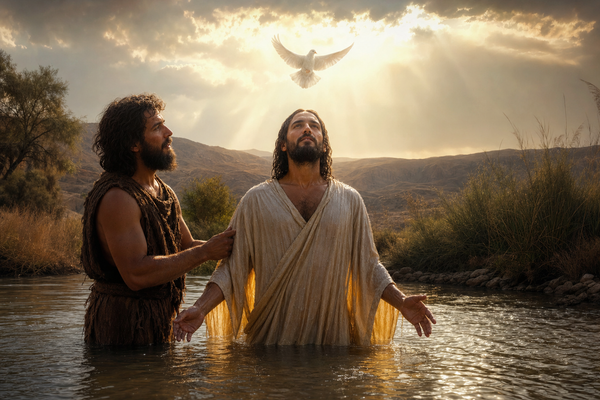
At Jesus' baptism, all three persons are revealed together. The Son stands in the water, the Holy Spirit descends like a dove, and the Father's voice comes from heaven: This is my beloved Son, with whom I am well pleased (Matthew 3:16–17). This is not one person switching between three roles. The Father, Son, and Spirit are present and acting distinctly.
Jesus also prays to the Father. On the night before His crucifixion, He says, Father, glorify me in your own presence with the glory that I had with you before the world existed (John 17:5). This prayer reveals a real relationship that existed before creation. The Son was with the Father and shared divine glory with Him.
The Father sends the Son into the world, and the Son willingly comes to accomplish the Father's will. Jesus says, I came down from heaven, not to do my own will but the will of him who sent me (John 6:38). This does not mean the Son has a sinful or rebellious will. It reveals His loving obedience within the work of salvation.
The distinction continues after the resurrection. Jesus tells Mary Magdalene, I am ascending to my Father and your Father, to my God and your God (John 20:17). Later, the apostles preach that God raised Jesus from the dead and exalted Him. The Father and the Son remain distinct persons even though the Son fully shares the divine nature.
This helps us understand Jesus' words in John 14:28: The Father is greater than I. Taken alone, that sentence can sound as if Jesus is denying His deity. But the surrounding context concerns His earthly mission and His return to the Father. The eternal Son had humbled Himself, taken the form of a servant, and entered our human condition.
Philippians 2 explains this movement. Christ existed in the form of God and possessed equality with God, yet He emptied Himself—not by surrendering deity, but by taking the form of a servant and becoming human (Philippians 2:6–8). His humility concerns His role and mission, not an inferior divine nature.
A king who kneels to serve does not cease to be king. In an infinitely greater way, the Son's obedience does not make Him less divine. It displays the depth of God's love and the humility of Christ.
We can therefore say clearly: Jesus is God the Son, not God the Father. The Father did not die on the cross; the incarnate Son gave His life. The Son did not pray to Himself; He prayed to His Father. Yet the Son is not a lesser god. He eternally shares the one divine being with the Father and the Holy Spirit.
One God in Three Persons
The Bible begins with the truth that there is only one God. Israel confessed, Hear, O Israel: The Lord our God, the Lord is one (Deuteronomy 6:4). Through Isaiah, God declares, I am the Lord, and there is no other (Isaiah 45:5).
Jesus and the apostles never abandon this belief. Jesus affirms that the Lord is one (Mark 12:29), and Paul writes, There is no God but one (1 Corinthians 8:4). Christianity is not the worship of three gods.
At the same time, Scripture identifies the Father as God, the Son as God, and the Holy Spirit as God. Each person speaks, acts, loves, and relates personally. They are distinct from one another, yet Scripture insists that God is one.
The doctrine of the Trinity brings these truths together:
- There is one God.
- The Father, Son, and Holy Spirit are each fully divine.
- The Father, Son, and Holy Spirit are distinct persons.
These are not three competing statements. Together they summarize the biblical witness.
Jesus reflects this reality in His command to make disciples and baptize them in the name of the Father and of the Son and of the Holy Spirit (Matthew 28:19). Notice that Jesus says name, singular, while naming three distinct persons. Father, Son, and Spirit are united under the one divine name.
Paul uses a similar pattern when he blesses the Corinthian church: The grace of the Lord Jesus Christ and the love of God and the fellowship of the Holy Spirit be with you all (2 Corinthians 13:14). The Christian life is lived in relationship with the triune God.
No human analogy can fully explain this mystery. Water as ice, liquid, and vapor can suggest one substance in three forms, but it risks implying that God merely changes modes. A person who is simultaneously a father, son, and employee still remains one person playing different roles. That also falls short because Father, Son, and Spirit genuinely relate to one another.
The Trinity does not mean that one God is three Gods or that one person is three persons. That would be a contradiction. It means that God is one in being and three in person. We may not fully comprehend how God's eternal life exists, but we can understand what Scripture affirms and what it denies.
Mystery is not the same as nonsense. If God is the infinite Creator and we are finite creatures, we should expect His being to exceed our complete understanding. Our task is not to reduce God to something easily pictured. It is to receive His self-revelation with humility and trust.
The Son Became Truly Human
The question becomes even richer because Jesus is not only fully God. In the incarnation, the eternal Son also became fully human.
John writes, The Word became flesh and dwelt among us (John 1:14). The Son did not stop being God when He entered the world. Nor did He merely appear human. He took a genuine human nature, was born, grew, became tired, felt sorrow, suffered, and died.
Jesus is therefore one person with two natures: truly God and truly human. His deity and humanity are not blended into a third kind of nature, and neither nature cancels the other.
This helps explain passages that can otherwise seem confusing. As God, the Son existed before Abraham and could say, Before Abraham was, I am (John 8:58). As a human being, He was born during the reign of Caesar Augustus and grew up in Nazareth. In His divine authority, He calmed the sea. In His humanity, He slept in the boat. He knew what was in people, yet He also experienced the ordinary limitations and sufferings of genuine human life.
His humanity was essential to our salvation. Humanity sinned, so the Savior came as the faithful representative of humanity. He obeyed where Adam and all of us have failed. He experienced temptation without sin and offered His life on behalf of sinners.
His deity was also essential. No merely human teacher could bear the full weight of sin, conquer death, reveal the Father perfectly, and give eternal life. Because Jesus is both God and man, He is the unique mediator who brings us to God.
Paul writes, There is one God, and there is one mediator between God and men, the man Christ Jesus (1 Timothy 2:5). Calling Jesus the mediator does not deny His deity. It emphasizes His saving role as the incarnate Son who stands with us and brings us into fellowship with the Father.
This is why the identity of Jesus is not a minor theological issue. The gospel depends on who He is. If Jesus were only human, He could not save us completely. If He had not truly become human, He could not represent us or die our death. The biblical hope is that God the Son came personally to rescue us.
Why This Truth Matters
Understanding the relationship between God and Jesus changes how we read the Bible, understand salvation, and approach God in prayer.
First, Jesus reveals God to us. He says, Whoever has seen me has seen the Father (John 14:9). This does not mean Jesus is the Father. It means the Son perfectly makes the Father known. God's holiness, compassion, truth, authority, and mercy are visible in the life of Christ.
When Jesus welcomes the repentant, touches the unclean, confronts hypocrisy, weeps at a tomb, and gives Himself on the cross, we are not seeing a kinder Son persuade a reluctant Father to love us. The Father sent the Son because of His love for the world (John 3:16), and the Son willingly laid down His life. Salvation flows from the united love and purpose of the triune God.
Second, Jesus is worthy of our worship. The risen Christ is not merely an example to admire. He is Lord. Every knee will bow and every tongue confess that Jesus Christ is Lord, to the glory of God the Father (Philippians 2:10–11). Worship of the Son does not compete with worship of the Father; it glorifies the Father.
Third, this truth gives confidence in salvation. Jesus says that no one can snatch His people from His hand, and then says no one can snatch them from the Father's hand (John 10:28–30). The Father and Son act together to preserve those who belong to Christ. Our hope rests not in our ability to hold tightly enough to God, but in the power and faithfulness of God who holds us.
Finally, the Trinity shapes prayer. Christians commonly pray to the Father, through the Son, in the Holy Spirit. We approach the Father because the Son has reconciled us to Him, and the Spirit helps us in our weakness. Yet because Father, Son, and Spirit are one God, prayer is fellowship with the one triune God rather than three separate deities.
So, are God and Jesus the same? If God refers to the one divine being, then yes: Jesus is fully God. If God refers specifically to the Father, then no: Jesus is the Son, not the Father. The Son shares the same divine nature as the Father while remaining personally distinct from Him.
This is more than a formula to memorize. It is an invitation to know the God who has made Himself known. The Father loved and sent, the Son came and gave Himself, and the Spirit opens our hearts to believe and brings us into God's family.
As you read Scripture, pay attention to how the Father, Son, and Holy Spirit speak and act. Linger especially in John 1, John 10, John 14–17, Philippians 2, Colossians 1, and Hebrews 1. Rather than forcing every passage into a quick answer, allow the full witness of Scripture to deepen your wonder at who Jesus is.
StudyBible.io can serve as a helpful companion as you explore these passages, compare their context, and follow the Bible's unified testimony about the Father, the Son, and the Holy Spirit.