
Why Did Jesus Wash the Feet of His Disciples? The Meaning of John 13
Jesus washed His disciples' feet to reveal His self-giving love, their need for spiritual cleansing, and the humble pattern His followers should imitate. The basin and towel ultimately point toward the cross.
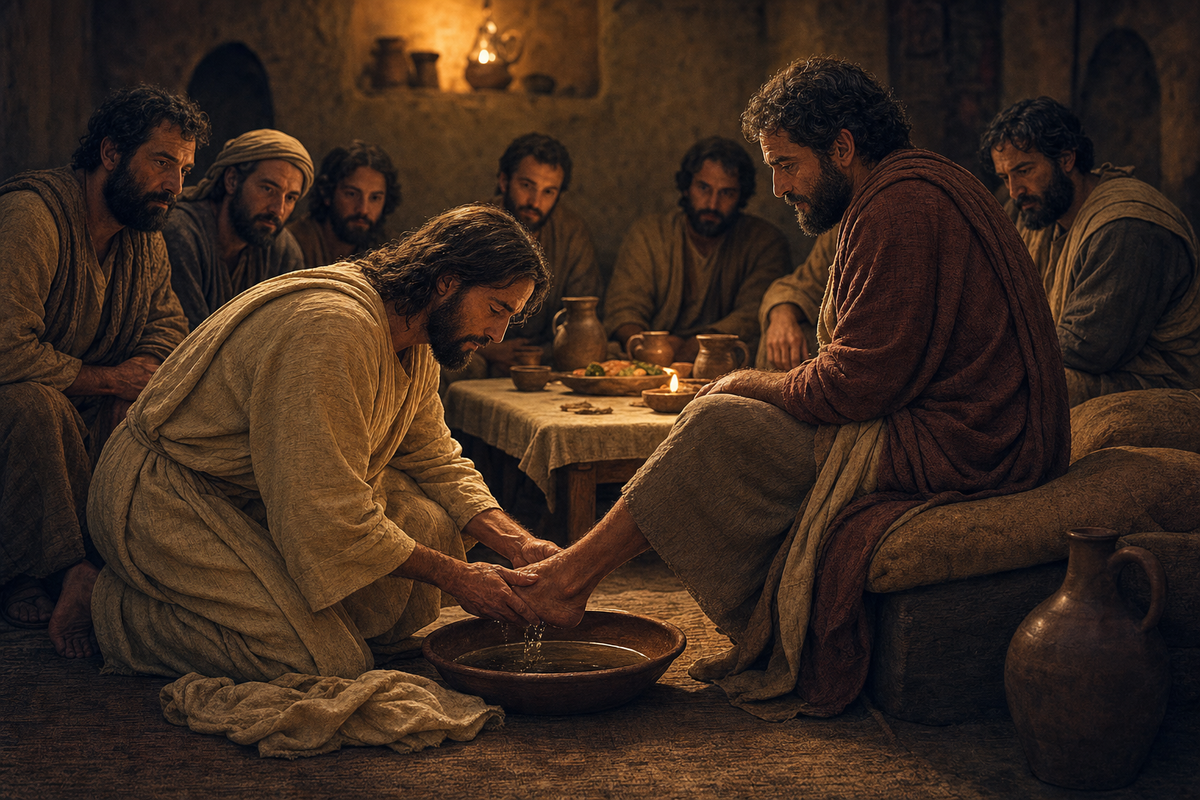
Why did Jesus wash the feet of His disciples? On the surface, He was performing a humble act of hospitality. But John 13 shows that the moment carried a far deeper meaning. Jesus was revealing the nature of His love, showing the disciples their need to be cleansed by Him, and giving them a pattern for serving one another.
Jesus washed His disciples' feet to show that His kingdom is marked by self-giving love rather than status, pride, or power. The act also pointed beyond dusty feet to the spiritual cleansing He alone provides, ultimately through His death on the cross.
This was not merely a lesson in good manners. It was a visible picture of the gospel, given on the night before Jesus laid down His life.
An Upper Room and a Servant's Work
John places the foot washing just before the Passover and immediately before Jesus' arrest and crucifixion. Jesus knew that His appointed hour had come. John introduces the scene by saying that Jesus, having loved his own who were in the world, he loved them to the end (John 13:1).
That statement frames everything that follows. What Jesus did with the basin and towel was an expression of His enduring, complete, and costly love.
Foot washing was a familiar need in the ancient world. People commonly traveled on dusty roads in open sandals, so their feet became dirty. A host might provide water for guests, and the actual washing could be performed by a household servant. It was lowly work, not a task normally associated with a respected teacher presiding over a meal.
Yet during supper, Jesus rose from the table, removed His outer garments, wrapped a towel around Himself, poured water into a basin, and began washing the disciples' feet (John 13:3–5). The disciples called Him Teacher and Lord, and rightly so. Still, the One with the highest position willingly took the place of a servant.
John makes the contrast especially striking by telling us what Jesus knew. He knew that the Father had given all things into His hands. He knew that He had come from God and was returning to God. Jesus did not serve because He was uncertain about His identity. He served from the security of knowing exactly who He was and where He was going.
His humility was not weakness or a denial of His authority. It was the righteous expression of divine authority. Jesus showed that godly power does not grasp for recognition; it gives itself for the good of others.
Love That Willingly Bends Low
The foot washing reveals what the love of Jesus is like. His love is not merely an emotion or a warm intention. It moves toward people, takes the lower place, and accepts a cost.
This becomes even more remarkable when we remember who was in the room. The disciples were still spiritually immature. Peter would soon deny Jesus. The others would scatter. Judas had already determined to betray Him and remained present during the foot washing; John records no exception in Jesus' act of service.
Jesus was not naive about any of them. He knew what was in their hearts and what they would do. His service did not depend on their worthiness.
That does not mean Jesus ignored unbelief or treated betrayal as harmless. Later in the passage, He clearly distinguished Judas from the others, saying, Not all of you are clean (John 13:11). Christlike love is never dishonest about sin. Nevertheless, Jesus' knowledge of human failure did not prevent Him from displaying the character of holy love.
This helps us understand the phrase he loved them to the end. It includes the idea that Jesus loved His own fully and faithfully, all the way to the completion of His mission. The towel points toward the cross. The Lord who stooped to wash feet would soon humble Himself even further by giving His life for sinners.
The disciples expected the Messiah to reign, and He would. But Jesus showed them that His reign could not be understood through worldly ideas of greatness. In His kingdom, greatness is expressed through sacrificial service. As He said elsewhere, the Son of Man came not to be served but to serve, and to give his life as a ransom for many (Mark 10:45).
A Washing Deeper Than Water
Peter's reaction shows that Jesus was doing more than cleaning feet. When Jesus came to him, Peter protested. The idea of his Lord performing such a lowly task felt completely inappropriate. Peter's response may sound humble, but it was also resistance. He wanted to decide what Jesus should and should not do for him.
Jesus answered, What I am doing you do not understand now, but afterward you will understand (John 13:7). Peter then insisted that Jesus would never wash his feet. Jesus replied with words that reveal the spiritual meaning beneath the physical action: Unless I wash you, you have no share with me (John 13:8).
At that point Peter rushed to the opposite extreme and asked Jesus to wash his hands and head as well. Jesus gently corrected him, explaining that one who had bathed needed only to wash his feet and was otherwise clean (John 13:10).
The foot washing was therefore both a real act of service and a sign pointing to a greater cleansing. Peter could not cleanse himself or establish fellowship with Jesus on his own terms. He had to allow Jesus to serve him and make him clean.
This truth stands at the heart of the gospel. Sin is not a stain we can remove through moral effort, religious activity, or sincere intentions. We need Christ to cleanse us. His death provides the forgiveness and purification we could never produce for ourselves. Revelation describes those redeemed by Christ as having washed their robes and made them white in the blood of the Lamb (Revelation 7:14). The surprising image communicates that Jesus' sacrificial death cleanses guilty people before God.
Christians have understood the distinction between being bathed and having one's feet washed in several related ways. Many see the bath as a picture of the decisive cleansing received through faith in Christ, while the washing of the feet reflects the believer's continuing need to bring daily sin and defilement before Him. The passage does not invite us to build every detail into a rigid system, but its central message is clear: every part of our cleansing depends on Jesus.
A person who belongs to Christ has been truly made clean, yet believers still stumble and need His restoring grace. Scripture calls Christians to confess their sins, trusting that God is faithful and just to forgive and cleanse them (1 John 1:9). This confession does not mean earning salvation again. It means living in honest dependence upon the Savior who has already acted to save.
Judas provides a sobering contrast. He was physically close to Jesus and participated in the life of the disciples, but Jesus said he was not clean. Outward association with Christian things is not the same as inward faith in Christ. Bible knowledge, church participation, or familiarity with Jesus' teaching cannot replace personally receiving Him.
Peter needed to stop resisting and be washed. Judas needed the inward cleansing that he did not receive. In different ways, both remind us that no one stands above the need for grace.
The Pattern Jesus Gave His Followers
After washing their feet, Jesus put His garments back on, returned to the table, and explained His actions. He said, If I then, your Lord and Teacher, have washed your feet, you also ought to wash one another's feet (John 13:14). He had given them an example to follow.
Some Christian traditions practice literal foot washing as an act of worship and obedience. Others understand Jesus' command primarily as a call to the humble service that foot washing represented in that culture. Christians may differ over whether this should be observed as a regular church ordinance, but the essential command cannot be avoided: followers of Jesus must be willing to take the low place and serve one another in practical ways.
Jesus did not stop being Lord when He picked up the towel. In fact, He deliberately reminded the disciples of His authority: You call me Teacher and Lord, and you are right, for so I am (John 13:13). He was not abolishing every role or distinction among believers. He was redefining how authority and leadership should be exercised.
Christian leadership must never be built on pride, domination, or the desire to be treated as important. Those entrusted with responsibility are called to use it for the spiritual good of others. The closer our leadership resembles Christ, the more willing we will be to perform work that receives little notice or praise.
This principle applies beyond formal leadership. Washing one another's feet can take the form of caring for someone who cannot repay us, helping with an unnoticed need, listening patiently to a burdened person, welcoming an overlooked individual, or doing ordinary work without demanding recognition. It may mean offering practical care when service is inconvenient and costly.
Yet Christlike service is more than being agreeable. Jesus served in truth. He named sin, corrected His disciples, and called people to repentance. Following His example does not require enabling destructive behavior, pretending that evil does not matter, or abandoning biblical wisdom. Genuine service seeks another person's true good under the authority of God's Word.
Jesus also said that the disciples should wash one another's feet. The command is mutual. Pride can appear not only in our refusal to serve but also in our refusal to be served. Sometimes we resist receiving help because we want to appear independent, strong, or spiritually mature. Peter's protest shows that receiving humble care can expose pride just as clearly as giving it.
The Christian community is not meant to consist of a few important people serving as benefactors while everyone else remains dependent. It is a body in which believers receive grace from Christ and then minister that grace to one another. No act of faithful service is beneath a disciple, because no disciple is greater than the Master.
Jesus made this explicit: A servant is not greater than his master, nor is a messenger greater than the one who sent him (John 13:16). If the Lord of glory took up the towel, His followers cannot claim that humble service is beneath them.
Receive His Grace, Then Take Up the Towel
The order of John 13 matters. Jesus washed the disciples before telling them to follow His example. Christianity does not begin with our service for Jesus. It begins with His service for us.
Before asking how you can wash someone else's feet, consider whether you are willing to be washed by Christ. Have you acknowledged that you cannot cleanse yourself? Are you trusting His death and resurrection rather than your own goodness? Are you bringing present sin into His light instead of hiding it or attempting to manage it alone?
Only those who receive the grace of Jesus can reflect the humility of Jesus. Otherwise, service can become another way to prove ourselves, gain approval, control others, or establish a reputation for goodness. The gospel frees us from that burden. We do not serve to make Christ accept us; we serve because in Christ we have received mercy we did not earn.
The foot washing also prepares us for Jesus' command later in the chapter: Just as I have loved you, you also are to love one another (John 13:34). The standard is not simply that we should be nicer or more helpful. We are to love in light of the way Christ has loved us—humbly, truthfully, patiently, and sacrificially.
The fullest meaning of the basin becomes visible at the cross. There Jesus went lower than any servant's position, bearing shame and giving Himself for sinners. Philippians 2 says that He took the form of a servant, humbled Himself, and became obedient to the point of death on a cross. God then highly exalted Him (Philippians 2:6–11). In Jesus, humility and glory are not opposites. His glory shines through His self-giving love.
That is why Jesus washed His disciples' feet. He was showing them who He is, what He had come to do, and what life in His kingdom looks like. He is the Lord who serves, the Savior who cleanses, and the Master whose followers are called to love as He loved.
As you read John 13, do not stop at admiring Jesus' humility. Let the passage lead you to receive His cleansing, examine your own resistance to humble service, and ask whose needs God has placed in front of you. The towel and basin point us toward a life shaped by the cross—a life that rests in Christ's grace and willingly bends low for the good of others.
For a deeper study of John 13 and its surrounding context, StudyBible.io can help you explore related passages, themes, and biblical insights as you read.