
When Was Jesus Born? What the Bible Says About the Month and Day
The Bible never identifies the exact month and day of Jesus’ birth, and December 25 is a historic tradition rather than a confirmed date. What Scripture does reveal clearly is who Jesus is and why His coming changes everything.
If you are wondering when Jesus was born—especially the exact month and day—the most honest answer is that the Bible does not tell us. Scripture gives important historical details surrounding His birth, but it never identifies a calendar date.
December 25 has been observed as Christmas Day by many Christians for centuries, yet Scripture does not say that Jesus was born on that date. Various theories place His birth in the spring, fall, or winter, but none can be proven conclusively from the biblical text.
That uncertainty does not make the birth of Jesus uncertain. The Gospels present His coming as a real event in human history, rooted in identifiable places, rulers, families, and promises. We may not know the date on which Jesus was born, but we can know why His birth matters—and that is where Scripture places its emphasis.
Does the Bible Give Jesus’ Exact Birth Date?
Neither Matthew nor Luke, the two Gospels that describe Jesus’ birth, provides a month or day. Matthew connects the event with the reign of Herod the Great, while Luke places it within the wider world of the Roman Empire:
“In those days a decree went out from Caesar Augustus that all the world should be registered” (Luke 2:1).
Luke then tells us that Joseph traveled with Mary from Nazareth to Bethlehem. While they were there, Mary gave birth, wrapped Jesus in cloths, and laid Him in a manger because there was no suitable guest room available to them (Luke 2:4–7).
These details show that Luke intended readers to understand Jesus’ birth as history, not as a timeless legend. Caesar Augustus, Bethlehem, Nazareth, Judea, shepherds, and the family line of David all locate the event in the real world. Yet Luke does not provide a date in the way a modern birth certificate would.
This was not unusual in the ancient world. People did not always record birthdays with the precision expected today. The Gospel writers were also pursuing a deeper purpose. They wanted readers to know who Jesus is: the promised Messiah, the Son of David, the Savior, and the Son of God.
The angel’s announcement to the shepherds captures that emphasis:
“For unto you is born this day in the city of David a Savior, who is Christ the Lord” (Luke 2:11).
The phrase “this day” tells us that Jesus was born on an actual day, but Luke does not name that day. His concern is not that believers commemorate the correct square on a calendar. His concern is that they recognize the Child as Savior, Christ, and Lord.
The absence of an exact date is therefore not a flaw in the biblical account. Scripture tells us everything necessary to understand the meaning of Christ’s coming, even when it does not answer every question our curiosity may raise.
Was Jesus Born on December 25?
The Bible neither confirms nor denies December 25 as the date of Jesus’ birth. It simply does not address the question.
By the fourth century, Christians in Rome were observing Christ’s birth on December 25. The reasons this date came to be used are debated. Some connect it with an early Christian calculation that placed Jesus’ conception on March 25; adding nine months leads to December 25. Others point to the date’s relationship with Roman winter festivals and the symbolism of light appearing during the darkest part of the year. Historical developments may have involved more than one factor.
Because the evidence is incomplete, confident claims should be treated carefully. It is too strong to say that the apostles taught Jesus was born on December 25. It is also too simplistic to claim that Christmas is nothing more than a pagan festival renamed by Christians. The history is more complicated than either statement suggests.
What can be said with confidence is that December 25 became a traditional day for remembering Christ’s birth, not a date explicitly established by Scripture.
Christians should therefore distinguish between biblical truth and church tradition. Biblical truth tells us that the eternal Son truly took on human nature and was born in Bethlehem. Church tradition assigns an annual date on which many believers remember and celebrate that event.
A tradition is not automatically wrong merely because it is not commanded in Scripture. At the same time, it should not be presented as though it carries the authority of Scripture. Romans 14 offers a helpful principle for questions involving special days:
“One person esteems one day as better than another, while another esteems all days alike. Each one should be fully convinced in his own mind” (Romans 14:5).
A Christian may celebrate Christmas on December 25 with sincere gratitude to Christ. Another believer may choose not to observe the day. Neither should condemn the other over a practice Scripture does not command or forbid. What matters is whether the conscience is directed by faith, love, and a desire to honor the Lord.
Celebrating Christmas does not require claiming that December 25 is Jesus’ proven birthday. It can simply be a chosen time to remember the incarnation, worship Christ, serve others, and tell the good news of His coming.
Do the Shepherds Reveal the Month?
One of the most common arguments about the timing of Jesus’ birth comes from Luke’s description of the shepherds:
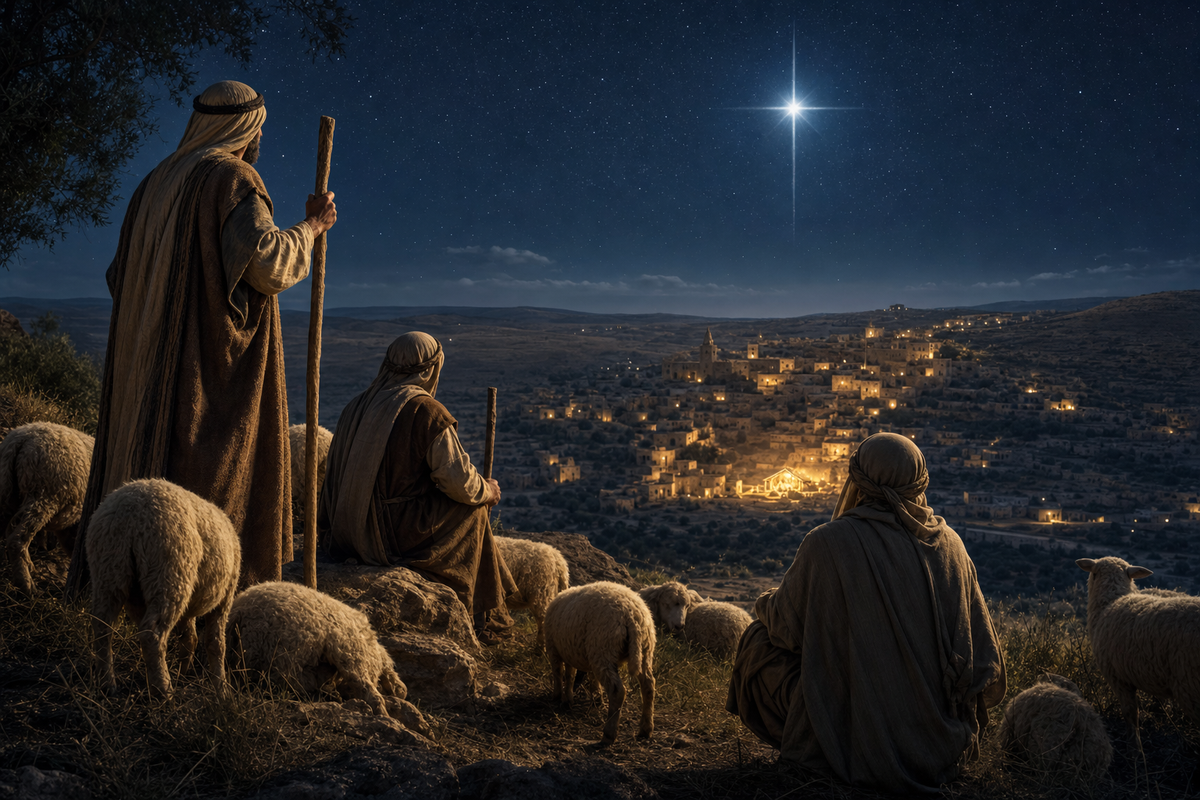
“And in the same region there were shepherds out in the field, keeping watch over their flock by night” (Luke 2:8).
Some conclude that Jesus could not have been born in December because shepherds would not have been outside with their flocks during winter. This observation deserves consideration, but it does not settle the question.
Winters around Bethlehem can be cold and rainy, especially at night. That may make spring or fall seem more likely to some interpreters. Yet the climate is not uniformly severe, and shepherding practices could vary depending on weather, location, available shelter, and the type of flock being kept. The text says the shepherds were in the fields that night; it does not tell us which season it was.
For that reason, the shepherds cannot prove a December birth, but neither can they conclusively rule it out.
Another theory begins with Zechariah, the father of John the Baptist. Luke says Zechariah belonged to the priestly division of Abijah and was serving in the temple when an angel announced that his wife, Elizabeth, would bear a son (Luke 1:5–13). Luke later tells us that Mary conceived Jesus when Elizabeth was in the sixth month of her pregnancy (Luke 1:26, 36).
Some have tried to calculate when the division of Abijah served, estimate the conception of John, and then add approximately fifteen months to determine the birth of Jesus. Depending on the assumptions used, this approach is sometimes offered as support for a fall birth and sometimes for another season.
The difficulty is that the necessary dates are not securely known. Priestly divisions served in recurring rotations, all divisions could serve during major festivals, and disruptions in Israel’s history complicate attempts to connect a particular rotation with a modern calendar date. Luke does not tell us which annual rotation was involved or precisely when Elizabeth conceived after Zechariah returned home.
The calculation is interesting, but it cannot establish Jesus’ birth month with certainty.
The star seen by the magi also does not provide a reliable month and day. Matthew tells us that the magi saw the star and came to worship the King of the Jews (Matthew 2:1–2), but he does not identify the star in a way that permits a universally accepted astronomical calculation. Nor does Matthew say that the magi arrived on the night Jesus was born. By the time they visited, Matthew calls Jesus a “child” and describes the family as being in a house (Matthew 2:11).
These details remind us to avoid building certainty on possibilities. The shepherds, Zechariah’s priestly service, and the star all contribute to the richness of the biblical account, but none reveals an exact birthday.
What Year Was Jesus Born?
Although the month and day are unknown, historians often estimate that Jesus was born sometime around 6 to 4 BC. That can sound strange because the BC and AD calendar was intended to center history on Christ. The explanation is that the calendar system was developed centuries after Jesus’ birth, and the calculation appears to have been off by several years.
Matthew provides an important historical marker by stating that Jesus was born “in the days of Herod the king” (Matthew 2:1). Herod the Great is traditionally dated as dying in 4 BC, although some details of the chronology remain debated. If that date is correct, Jesus must have been born before then.
Matthew also records that Herod ordered the killing of boys in Bethlehem who were two years old or younger, basing the range on information he had received from the magi (Matthew 2:7, 16). This does not mean Jesus was necessarily two years old. Herod may have chosen a broad range to ensure that the Child would be killed. Still, the passage suggests that some time may have passed between Jesus’ birth and the magi’s arrival.
Luke’s reference to the registration associated with Quirinius has generated significant discussion because of questions concerning Roman administrative chronology. Several explanations have been proposed, but the available evidence does not allow every historical question to be resolved beyond dispute. This should encourage humility rather than alarm. Ancient records are incomplete, while Luke repeatedly demonstrates careful attention to people, places, and public events.
A birth around 6 to 4 BC is therefore a common estimate, not an inspired date supplied by Scripture. We can responsibly speak of a likely range while admitting that the evidence does not permit precision.
It is also worth noting that the traditional calendar has no year zero. It moves from 1 BC directly to AD 1. This detail matters when people attempt to calculate dates across the dividing line.
Ultimately, the Gospels give enough chronological information to place Jesus within history, but not enough to reconstruct His birthday. That balance seems intentional: Christianity depends on events that truly happened, yet faith does not depend on solving every detail of ancient chronology.
Why the Birth of Jesus Matters More Than Its Date
The most important question is not, “On which day was Jesus born?” but, “Who was born, and why did He come?”
John’s Gospel does not describe the manger, the shepherds, or the magi. Instead, John reveals the eternal identity of the One who entered the world:
“And the Word became flesh and dwelt among us, and we have seen his glory” (John 1:14).
Jesus’ birth was the incarnation: the eternal Son of God truly became human without ceasing to be God. He did not merely appear to be human. He entered ordinary human life, experienced weakness and suffering without sin, and came to accomplish the salvation His people could never accomplish for themselves.
Matthew connects Jesus’ birth directly with this saving mission. The angel told Joseph:
“You shall call his name Jesus, for he will save his people from their sins” (Matthew 1:21).
The wonder of Bethlehem cannot be separated from the cross and resurrection. The Child in the manger came to bear sin, defeat death, and reconcile sinners to God. Christmas sentiment without that gospel center misses the reason Jesus came.
His birth also fulfills God’s promises. Jesus was born in Bethlehem, the city associated with David and identified in Micah’s prophecy as the place from which Israel’s ruler would come (Micah 5:2; Matthew 2:5–6). He was born of a virgin in fulfillment of the sign described by Isaiah and applied by Matthew to Christ (Isaiah 7:14; Matthew 1:22–23). He entered David’s royal line as the promised King.
These fulfillments are not included merely to make the birth story impressive. They show that God is faithful. Across generations of waiting, political upheaval, exile, and apparent silence, His promise did not fail. Paul summarizes the timing beautifully:
“But when the fullness of time had come, God sent forth his Son, born of woman, born under the law” (Galatians 4:4).
We may not know the calendar date, but Scripture tells us that Jesus came at the fullness of time. His birth was neither random nor late. It happened according to the wise purpose of God.
That truth offers something more lasting than a successful date calculation. Many people experience Christmas through family memories, cultural customs, grief, pressure, or nostalgia. Scripture invites us deeper. It calls us to behold Christ, receive the good news with faith, and respond as the shepherds did—with worship, witness, and praise.
After seeing Jesus, the shepherds made known what they had been told and returned “glorifying and praising God for all they had heard and seen” (Luke 2:20). Their response provides a fitting pattern for us. The nativity is not merely a scene to admire. It is news to believe and proclaim.
So, when was Jesus born? He was probably born sometime between 6 and 4 BC, but His exact month and day are unknown. December 25 is a historic Christian tradition, not a biblically verified birthday. The shepherds and other details offer possible clues, but they do not provide certainty.
Scripture directs our confidence elsewhere. Jesus truly came. God kept His promise. The Savior was born. Rather than allowing an unanswered calendar question to overshadow the passage, read Matthew 1–2 and Luke 1–2 slowly. Notice what each angel announces, how people respond, and what the names and titles of Jesus reveal. The greatest gift of the birth narratives is not the discovery of a date, but a clearer vision of Christ.
For a closer study of these passages, StudyBible.io can help you trace the context, cross-references, and promises woven throughout the biblical account of Jesus’ birth.